


Why Making Less Is a Design Choice
There's a reason some labels produce fewer pieces, and it has nothing to do with running out of fabric.
I've been thinking about this a lot lately. A friend asked me, genuinely, whether a brand she loved was "struggling" because they hadn't dropped a new collection in weeks.
She'd been conditioned to expect constant newness. A new drop every Friday. A countdown timer. A waitlist that exists mostly for drama. So when a label goes quiet, or keeps its range intentionally small, the assumption is that something's wrong. That the supply chain broke. That demand outpaced production. That they simply couldn't keep up.
But what if making less is the whole point? What if why making less is a design choice, not a supply problem, is actually the most honest answer a brand can give?
I want to talk about that. Because it matters more than most people realize, especially here in Dubai, where the relationship between abundance and taste is constantly being renegotiated.
The Pressure to Always Have Something New
Fashion loves volume. Always has. The industry rewards output. More SKUs, more drops, more colorways, more content to feed the algorithm.
And for a while, that model worked, or at least it looked like it did. Brands that released weekly could dominate social feeds, fill up search results, stay top of mind. Speed was strategy.
But speed has a cost that doesn't show up on a balance sheet. When you design fast, you repeat yourself. You borrow. You approximate. The garment that could have been refined over four months gets pushed out in four weeks, and the difference is something you can feel the moment you put it on. A seam that pulls. A hem that doesn't fall right. A fabric that photographs well but doesn't move well.
I've worn enough of those pieces to know the feeling. You buy something because it looked right on a screen, and then it arrives and it's just... adequate. Wearable, sure. But forgettable. The kind of thing that ends up in the back of your closet within two seasons, replaced by another version of itself.
The women I know in Dubai, the ones who dress with real intention, have started to notice this pattern, and they're tired of it.
What Restraint Actually Looks Like in Practice
There's a misconception that producing less means doing less work. The opposite is true. When your collection is small, every single piece carries weight. There's nowhere to hide. A 200-piece collection can absorb a few mediocre designs without anyone noticing. A 30-piece collection cannot.
I think about this every time I look at how NÓRA approaches their dresses. The range isn't enormous. It doesn't need to be. Each piece has a clear reason for existing. The Aurelie Maxi Dress in viscose knit, for example, does something very specific. It drapes in a way that feels considered, not accidental. The long sleeves work for the kind of indoor chill you get at a place like Zuma or La Petite Maison, and the viscose knit has that softness that synthetic fabrics imitate but never quite match.
That kind of precision takes time. More time than most brands are willing to spend on a single silhouette.
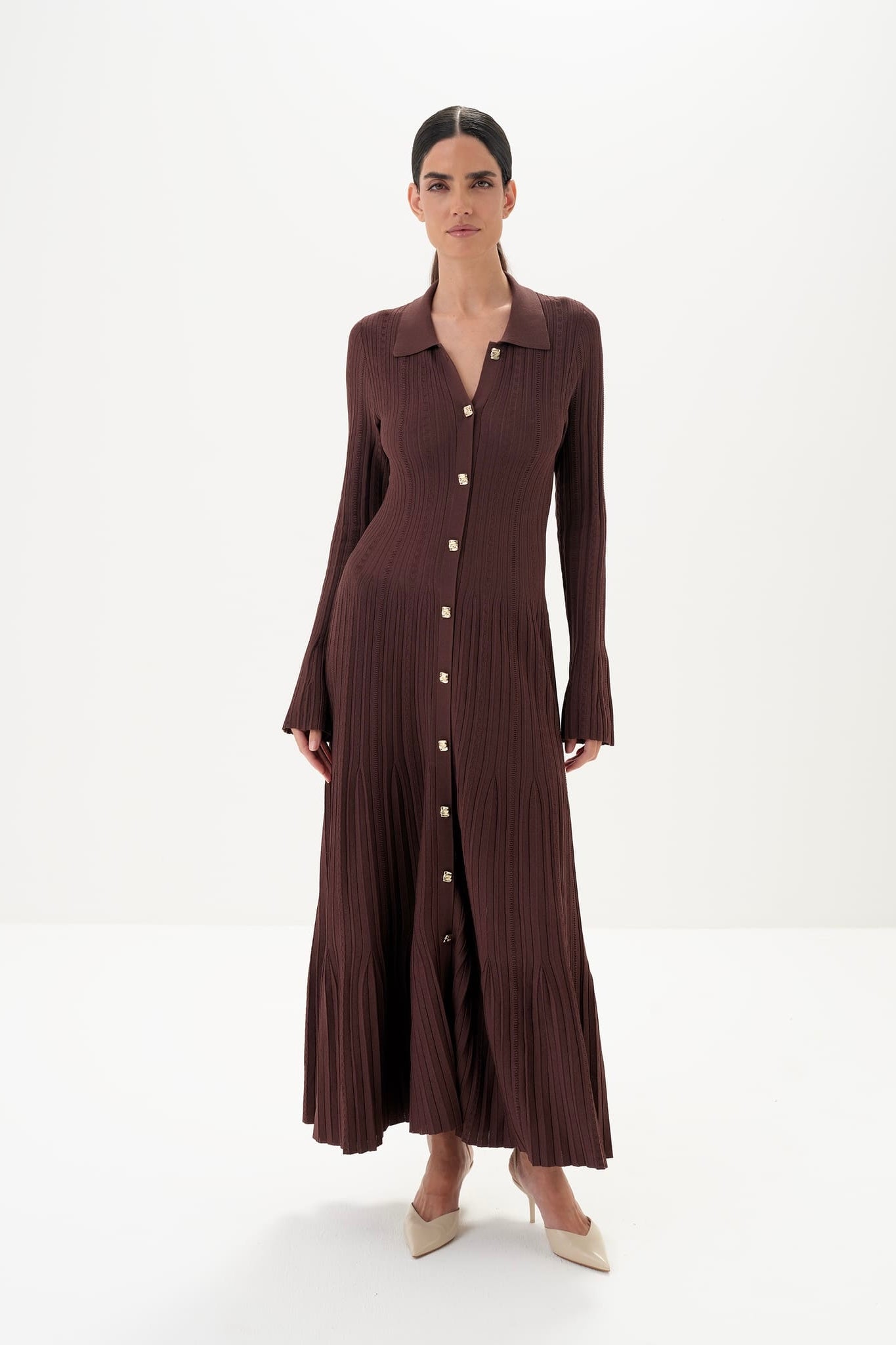
Restraint, in design, isn't about limitation. It's about making choices that hold up to scrutiny. It's about saying: we made twenty pieces this season because twenty was the right number, not because we couldn't figure out how to make forty.
Why "Less Is More" Still Means Something
I know. The phrase has been repeated so often it's almost lost its meaning. Mies van der Rohe said it about architecture. Then it got borrowed by minimalists, then by marketers, then by everyone trying to justify a capsule wardrobe on Instagram. But the original idea, stripped of all its trend-cycle baggage, is still worth paying attention to.
Less is more because editing is harder than adding. Anyone can add another option. Another color. Another variation.
To look at a collection and remove the piece that's good enough but not quite right. To leave a gap in the lineup rather than fill it with something that doesn't earn its place.
This is a design philosophy, not a marketing tactic. And the difference is visible. You can feel it when a brand has edited with care. The pieces relate to each other. They share a language. You can mix a top from one drop with a skirt from another and the conversation between them makes sense.
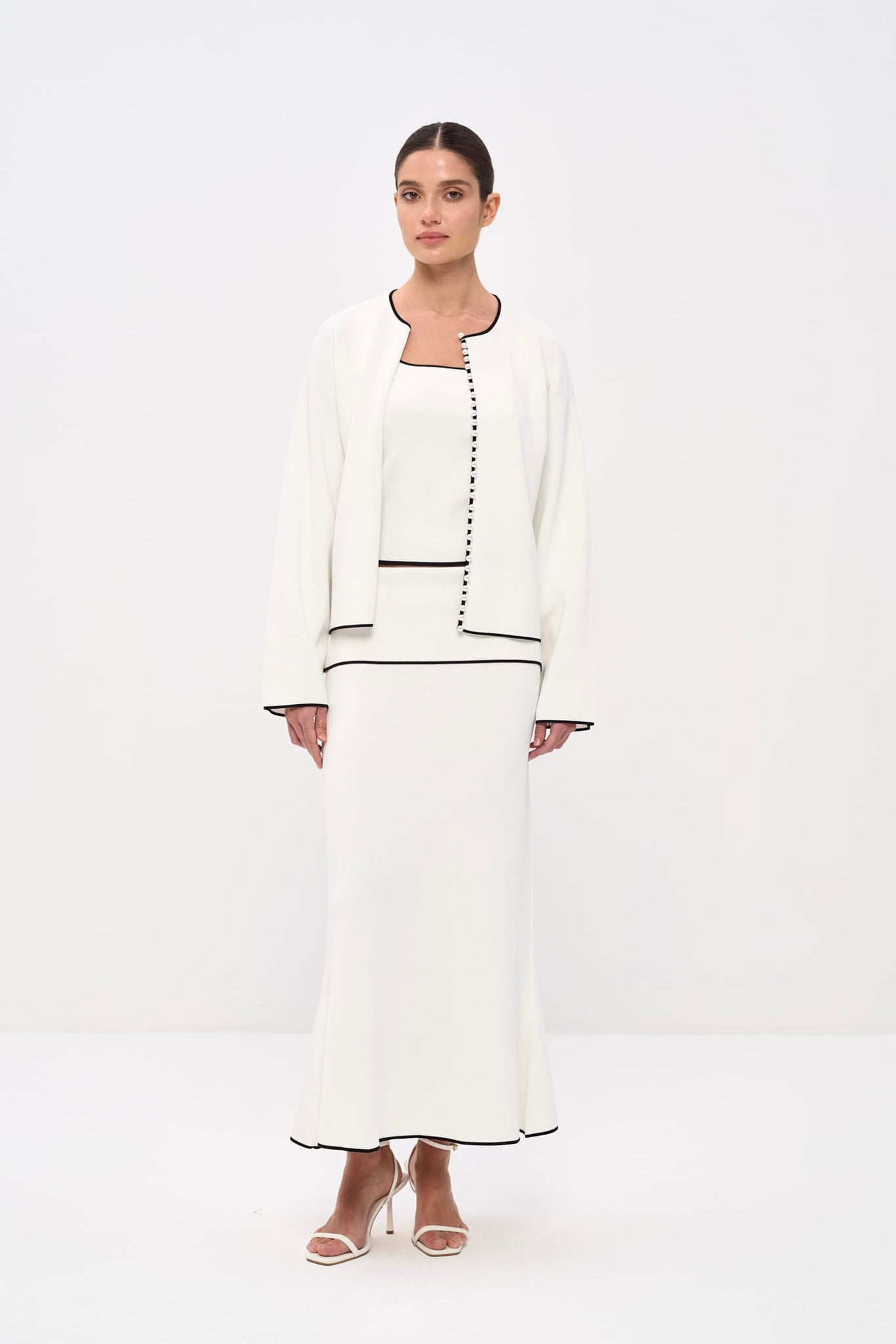
That's what I've noticed with NÓRA's sets. The three piece Seraphine Set in viscose knit reads as one complete thought, but you can also separate the pieces. The top works with the Rhea Maxi Skirt. The bottom works on its own with something simple. That kind of interchangeability doesn't happen by accident. It happens because someone sat with the proportions long enough to get them right.
The Dubai Factor
Dubai has a particular relationship with abundance. This is a city that builds the tallest, the largest, the most. And there's beauty in that ambition. I love living here, and I love the scale of what this city attempts.
But the women who dress best in Dubai, the ones you notice at a dinner in DIFC or a Friday brunch at Scalini, aren't the ones wearing the most. They're the ones wearing the right thing. One dress. One set. Chosen well. Worn with the kind of confidence that only comes from knowing the piece is exactly right for the moment.
Dubai's style has its own rhythm. It borrows from everywhere but copies nothing. And more women setting that rhythm are gravitating toward brands that respect their intelligence.
Brands that don't try to overwhelm them with options but instead offer a smaller, more purposeful selection and trust them to know what to do with it.
That trust is rare. Most brands hedge. They produce wide, hoping something will stick. But the ones that produce narrow, with conviction, tend to build something more lasting. A customer who buys one piece she loves will come back. A customer who buys five pieces she feels indifferent about probably won't.
Sustainability Without the Sermon
I'll be honest. The word "sustainable" has been used so loosely in fashion that it's almost lost its ability to communicate anything specific. Everyone claims it. Few define it.
But here's what I think actually qualifies: making what you need and not more.
Choosing fabrics like Naia satin, bamboo jersey, TENCEL lyocell, and viscose knit because they perform well and tread lighter on the planet, not because they look good in a press release.
Producing in quantities that match real demand rather than speculative demand. Not ending up with thousands of unsold units that get shipped to landfills or burned.
This is where why making less is a design choice, not a supply problem, intersects with something bigger than aesthetics. When a brand produces with intention, the environmental footprint shrinks. Not because they've bolted on a sustainability program, but because the model itself generates less waste. The restraint is built into the process.
I find this more convincing than any certification logo. A brand that makes 30 carefully considered pieces in responsible fabrics is doing more, quietly, than a brand that makes 500 pieces and donates 1% to an ocean cleanup. The math is simple. The execution is not.
What Gets Lost When You Make Too Much
There's a creative cost to overproduction that doesn't get discussed enough. Designers who are forced to produce on an accelerated calendar start to lose their eye. They stop seeing each piece individually. They think in bulk. In themes. In "stories" that are really just mood boards stretched thin across too many garments.
The pieces start to feel interchangeable. You could swap a dress from one fast-fashion brand with a dress from another and the customer might not notice. That's not a failure of the customer's taste. It's a failure of the design process. When you make too much, everything starts to look like everything else.
Smaller collections resist this. Each piece has room to breathe. The designer can spend a week on a single neckline, adjusting the depth, the angle, the way it sits against different body types. They can prototype in the actual fabric, not a stand-in, and see how it moves. They can wear it themselves, or have someone on their team wear it to dinner and report back. That feedback loop is only possible when you're working at a scale that allows attention.
I've spoken to the team behind NÓRA about this. Four sisters who started the label in 2020.
They talked about turning down wholesale orders that would have required them to scale production beyond what they could personally oversee. That takes a specific kind of discipline. The kind that doesn't make headlines but does make better clothes.
The Closet Test
Here's a question I ask myself before buying anything now: will I still reach for this in a year? Not "will it still be in style." Will I reach for it. Will it be the piece I grab when I'm running late for a dinner reservation, or packing for a weekend in Abu Dhabi, or getting dressed for something that matters.
(The kind of piece you pack first and reach for most.)
The things that pass this test tend to share a few qualities. They fit well. They're made from fabric that feels good against skin. They don't require a complicated styling strategy. They're refined without being stiff. And almost always, they come from brands that didn't try to make everything for everyone.
If you've been reading our thoughts on building a wardrobe that works here, we covered similar ground in our piece on signature statement pieces. The idea isn't to own less for the sake of owning less. It's to own things that actually do something for you.
Confidence in the Quiet Parts
There's a version of fashion that's loud. Constant launches. Influencer campaigns. Limited editions that aren't actually limited. That version works for some brands, and I'm not here to say it shouldn't exist.
But there's another version. Quieter. More deliberate. A brand releases a collection when it's ready, not when the marketing calendar says it should be ready. The pieces are designed to last beyond a single season. The fabrics are chosen for how they feel on the fourth wear, not just the first. The range is small enough that each piece gets the attention it deserves.
This version requires a different kind of confidence. The confidence to be still in an industry that rewards noise. To trust that the right customer will find you, not because you shouted the loudest, but because what you made was worth finding.
I think that's what distinguishes the labels that last from the labels that trend. Trending is easy. Lasting is the harder project. And lasting, almost always, starts with the decision to make less.
If you're curious about what intentional design looks like in practice, NÓRA's Resort '26 Collection are a good place to start. Not because the collection is large. Because it isn't.