


We Don't Call Ourselves Sustainable
Honest sustainability starts with admitting what you don't know. Here's NÓRA's point of view on fabric, intention, and what we actually owe you.
We've had this conversation internally more times than I can count. Someone suggests adding "sustainable brand" to the website. Someone else pushes back. Then we talk for an hour about what that word even means anymore, and we end up exactly where we started: unwilling to claim a title we haven't fully earned.
That's the honest version. And NÓRA’s point of view on sustainability begins there, in the willingness to sit with the discomfort of not having a perfect answer.
The Word That Means Everything and Nothing
Sustainability, as a concept, is beautiful. As a marketing term, it's been hollowed out. You've seen it on tags sewn into fast fashion. You've seen it in campaigns from companies that produce millions of units a month. You've seen it printed on packaging that arrives wrapped in three layers of plastic.
We're not here to point fingers at anyone else. That's not the point. The point is that a word used by everyone to mean anything eventually means nothing. And we'd rather talk about what we actually do.
We Choose Fabrics That Make Sense
Every piece we make starts with a fabric decision. That decision takes longer than you'd think. We work with Naia satin, which is derived from wood pulp sourced from sustainably managed forests. We use viscose knit, bamboo jersey, TENCEL lyocell. These aren't exotic or mysterious materials. They're well-documented, responsibly produced fibers with clear supply chains.
We chose them because they feel good on your skin, hold their shape after multiple wears, and don't require the kind of chemical processing that keeps us up at night. Something like the Melissa Draped Gown in bamboo jersey is a good example. Bamboo grows quickly, needs very little water, and the resulting fabric is soft enough that you forget you're wearing something "responsible." Which, honestly, is the whole idea. You shouldn't have to sacrifice how something feels for how it's made.
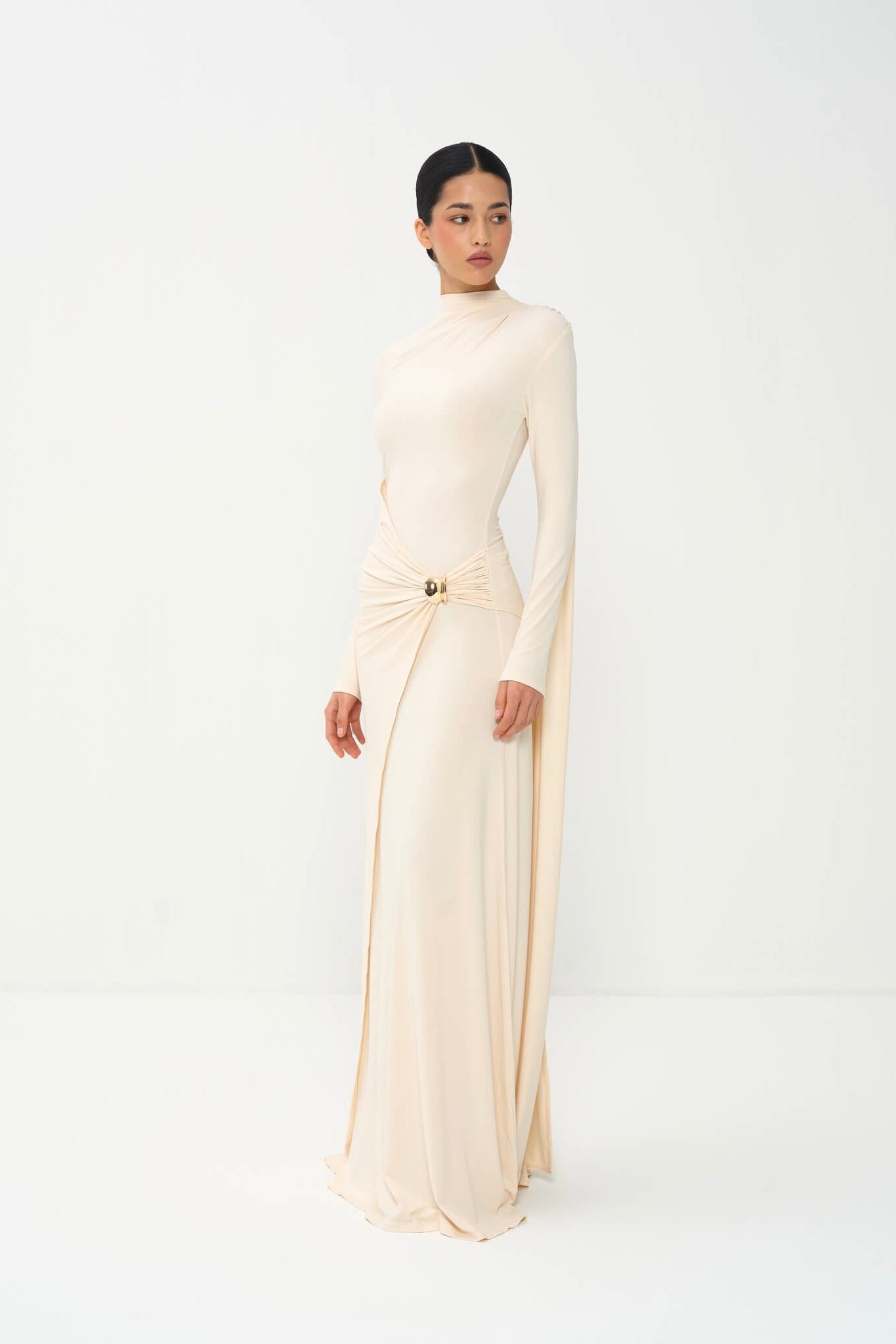
We didn't arrive at these fabrics through a sustainability audit or a consultant's recommendation. We arrived at them because we touched them. We wore them. We washed them. We wore them again. The responsible part was a bonus, not a headline.
What We Don't Do (And Why We Say So)
We don't manufacture at mass scale. We don't produce hundreds of units per style in anticipation of demand. Our runs are intentional. If something is out of stock, it's because we didn't make more than we thought we could sell. Sometimes that frustrates people. We understand that.
We also don't offset our carbon emissions through some third-party program that lets us claim neutrality. We've looked into it. The math is complicated, and a lot of those programs are more reassuring on paper than they are in practice. So instead, we try to keep our footprint small by producing locally, shipping from Dubai, and not overproducing.
We don't use phrases like "zero waste" because our production does create waste. Fabric scraps. Prototype runs that don't work out. Packaging materials. We minimize it where we can. We're honest about what remains.
This is what honest sustainability and NÓRA's point of view looks like in practice. It's less polished than a manifesto. It's more real.
Dubai Shapes How We Think About This
Living and working in Dubai changes your relationship with fabric. You notice what holds up in heat. You notice what wrinkles the moment you sit down. You notice what still looks intentional after a full day of moving between air-conditioned restaurants and the warm walk between your car and the door.
We covered this in more detail in our guide to what to wear in Dubai, but the short version is this: the climate here demands a certain kind of material.
Heavy synthetics don't work. Delicate fabrics that can't handle a second wear don't work. What works is something that breathes, drapes, holds its color, and travels well between.
That overlap, between what performs well and what's responsibly made, is where we've found our lane. It wasn't a branding exercise. It was practical.
Our sets, for instance, are mostly viscose knit. That's because viscose knit moves with you, stays soft after washing, and can go from a morning coffee at Hamptons to a dinner reservation without looking like it's been through anything. It also happens to be a fiber with a lower environmental impact than many alternatives. We'll take that convergence every time.
The Four Sisters Question
NÓRA was founded in 2020 by four sisters. People ask us all the time whether sustainability was always part of the vision.
The truthful answer is: not explicitly. What was always part of the vision was care. Care about what goes into a garment. Care about whether it would last. Care about whether we'd be proud of it in two years, not just the season it launched.
That kind of care leads you to better materials almost automatically. When you actually wear your own pieces, when your mother wears them, when your sister wears them to her engagement dinner, you become very particular about quality. You start asking harder questions of your suppliers. You start rejecting fabrics that pill after one wash, regardless of price.
Sustainability, for us, grew out of standards. Not the other way around.
Why We Won't Use the Word "Eco-Friendly"
There's a list of words we avoid. "Eco-friendly" is near the top. "Green." "Conscious collection." "Earth-first." These aren't bad words. They've just been used so loosely, by so many, that they no longer carry specific meaning.
When we describe a piece like the Azura Dress in TENCEL, we'd rather tell you what TENCEL is. It's a fiber made from wood cellulose, produced in a closed-loop process that recovers and reuses solvents. That sentence is less catchy than "eco-friendly dress." But it's accurate. And accuracy, in our opinion, is more respectful of your intelligence than a label.
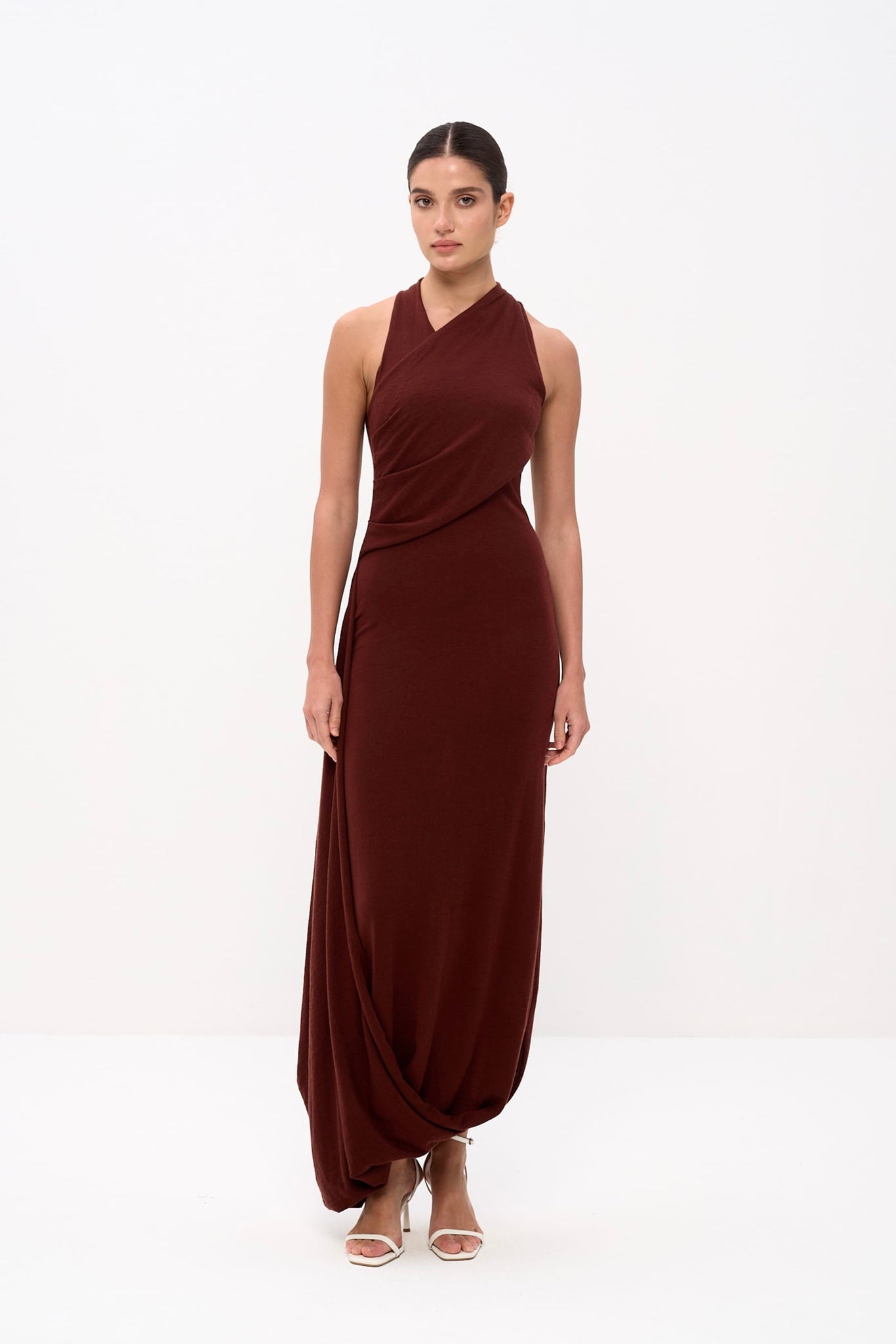
We think the women who wear NÓRA appreciate that. They're the same women who read ingredient lists, who ask where things come from, who've grown tired of being marketed to with vague promises. They deserve specifics.
What Longevity Has to Do With It
The most responsible garment is one you actually wear. Repeatedly. For years. This is something the sustainability conversation often skips over in favor of raw materials and carbon calculations. But the single most impactful thing a clothing brand can do is make something that doesn't end up in a donation bin after one season.
We think about this constantly. Every silhouette we design has to pass a simple test: will this feel dated in eighteen months? If the answer is even a maybe, we rethink it. Our dresses tend toward clean lines, considered draping, colors that don't belong to a single trend cycle. That's purposeful. A dress you reach for forty times is worth more, environmentally and personally, than four dresses you wear twice each.
Longevity is the part of sustainability that nobody wants to talk about, because it means producing less. Selling less. Growing slower. We're okay with that. We'd rather have a smaller customer base that wears NÓRA for years than a larger one cycling through our pieces like disposable content.
Where We Still Have Work to Do
Our packaging has improved, but it's not where we want it to be. We still use some plastics in shipping protection. We've reduced them, and we're testing alternatives, but we haven't eliminated them. That's the truth.
Our supply chain is relatively short because we're based in Dubai and produce locally, but "relatively short" is not the same as "perfectly transparent."
We know our suppliers. We visit our factories. We're confident in the conditions. But we haven't published a full supply chain audit because we don't think a half-done version would be helpful. When we do it, we want it to be thorough.
We're also still learning about end-of-life, what happens to a NÓRA piece when you're done with it. Can it be composted? Recycled? Some of our fabrics biodegrade more easily than others. We're researching this properly rather than making claims we can't back up.
This section might be the most important one in this entire post. Because a brand that only talks about what it's doing right is a brand that's performing. And performance is the opposite of honesty.
The Difference Between Perfect and Intentional
We will probably never be a perfectly sustainable brand. The concept itself might be impossible for any company that produces physical goods. Raw materials are extracted. Energy is consumed. Shipping generates emissions. These are facts that no amount of bamboo jersey can erase.
But we can be intentional. We can choose better over convenient. We can produce less and produce it well. We can tell you exactly what our fabrics are and where they come from. We can admit what we haven't figured out yet.
Honest sustainability and NÓRA's point of view isn't a tagline. It's a practice. Imperfect, ongoing, specific to who we are and where we work. We'd rather be a brand you trust than one you admire from a distance.
That trust is built slowly. One piece at a time. One honest conversation at a time. One fabric decision that you can feel the moment you put it on.
If you're curious about what intentional design actually looks like when you're wearing it, our new arrivals are a good place to start. Touch the fabric in our showroom. Read the description. Decide for yourself.