


Repair, Alter, or Replace? A Smarter Approach
Before you give up on a dress you once loved, ask yourself a better question. The answer might save the piece, or finally free you from it.
I had a silk dress I wore for three years straight. Every winter dinner, every birthday, every occasion that called for something I didn't have to think about. Then the zipper started catching. Then the hem came loose on one side. Then, honestly, my body changed. The dress still hung in my closet, but I stopped reaching for it. I kept thinking I'd get it fixed. I never did.
That limbo, the space between "I should repair this" and "maybe I should just let it go," is where most of us lose time and closet space.
The question of whether to repair, alter, or replace is one every woman with a real wardrobe eventually faces. And the answer is almost never obvious.
Most advice on this topic treats it like a math problem. Calculate cost per wear. Compare the repair bill to the replacement price. If it's under 50% of the original cost, fix it.
That logic isn't wrong. It's just incomplete. Because the decision is rarely about money alone. It's about how a piece makes you feel now, whether it still fits the life you're actually living, and whether you're holding on out of love or guilt.
When Repair Is the Right Call
A good tailor can do remarkable things. A replaced zipper takes twenty minutes. A restitched seam, even less. Loose buttons, small tears near a hem, a lining that's come undone. These are the easy wins. If the garment fits you well, if you still love it, and if the problem is mechanical rather than fundamental, repair it. Don't even hesitate.
The women I know who dress well tend to have a tailor on speed dial. Not for big transformations, just for maintenance. The same way you'd take a good pair of shoes to be resoled. It's not romantic. It's practical. And it extends the life of pieces that deserve more time in your rotation.
Here's a useful rule: if you'd wear it tomorrow, were it not for this one issue, then repair is almost always worth it. The fix should take less than a week and cost a fraction of what you paid.
In Dubai, you'll find skilled tailors in almost every neighborhood. Al Karama and Satwa have some of the best in the city, and most will quote you on the spot.
What's worth repairing: loose hems, broken zippers, missing buttons, small tears in low-stress areas, lining separation, minor pilling on knits you genuinely reach for.
When Alteration Changes Everything
Alteration is different from repair. Repair returns a garment to what it was. Alteration turns it into something closer to what you need it to be.
Maybe your body has shifted. Maybe your taste has. Maybe you bought a dress two years ago that was slightly too long and you wore heels with it every time, and now you'd rather wear it with flats. A good alteration can close the gap between a piece you own and the version of it you actually want.
I've had dresses taken in at the waist, skirts shortened by three inches, sleeves narrowed. Each time, the garment came back feeling like something new. Something that actually belonged in my current life, not the one I was living when I bought it.
But alteration has limits. And being honest about those limits is the part most people skip.
A dress that's two sizes too large can rarely be altered down without losing its proportions. A structured blazer with padded shoulders can be softened, but it can't become a relaxed, fluid piece. If the fabric itself has changed, if it's thinning, if it's lost its drape, if the color has faded unevenly, then no amount of stitching will bring it back. The bones of the garment have to be sound for alteration to make sense.
Ask yourself: do I love the fabric and the feeling of this piece, but the fit is off? Then alteration is your answer.
Do I love the memory of this piece, but honestly, it doesn't feel like me anymore? That's a different conversation.
The Guilt of Letting Go
This is the part nobody wants to talk about. We keep things because we feel bad about getting rid of them. Because they were expensive. Because someone gave them to us. Because we wore them during a particular chapter. Because we think sustainability means never releasing anything from our closet, ever.
But sustainability isn't about hoarding. It's about intention. A dress you never wear takes up space, physical and mental. It sits there making you feel vaguely guilty every time you open your closet. It creates noise in a space that should feel clear.
Letting go of a piece you've genuinely loved isn't wasteful. Keeping it in limbo is. Pass it to someone who'll wear it. Donate it. But free up that space for something that actually earns its place in your daily life.
I've written before about how our signature statement pieces tend to be the ones we return to without thinking. The rest, even the beautiful rest, sometimes just needs to move on.
How to Know It's Time to Replace
Replacing doesn't mean buying on impulse. It means recognizing that a gap in your wardrobe is real and filling it with something better than what came before.
A piece is ready to be replaced when:
The fabric has lost its integrity. Pilling you can't remove. Thinning at stress points. A drape that's gone flat. Fabric quality is the foundation. When that foundation shifts, everything on top of it looks a little off.
Your life has changed. The cocktail dress you wore every weekend in your twenties may not match a life that now involves school runs and working lunches and dinners that need to be slightly more covered. That's not a loss. It's just a different chapter, with different requirements.
The piece was never quite right. Some things we buy with optimism rather than clarity. They looked good in the fitting room under those lights, with that specific energy, on that specific day. At home, they never landed. If you've owned something for a year and worn it fewer than three times, the honest answer is usually that it wasn't the right piece to begin with. Replace the idea it represented, this time with something that actually works.
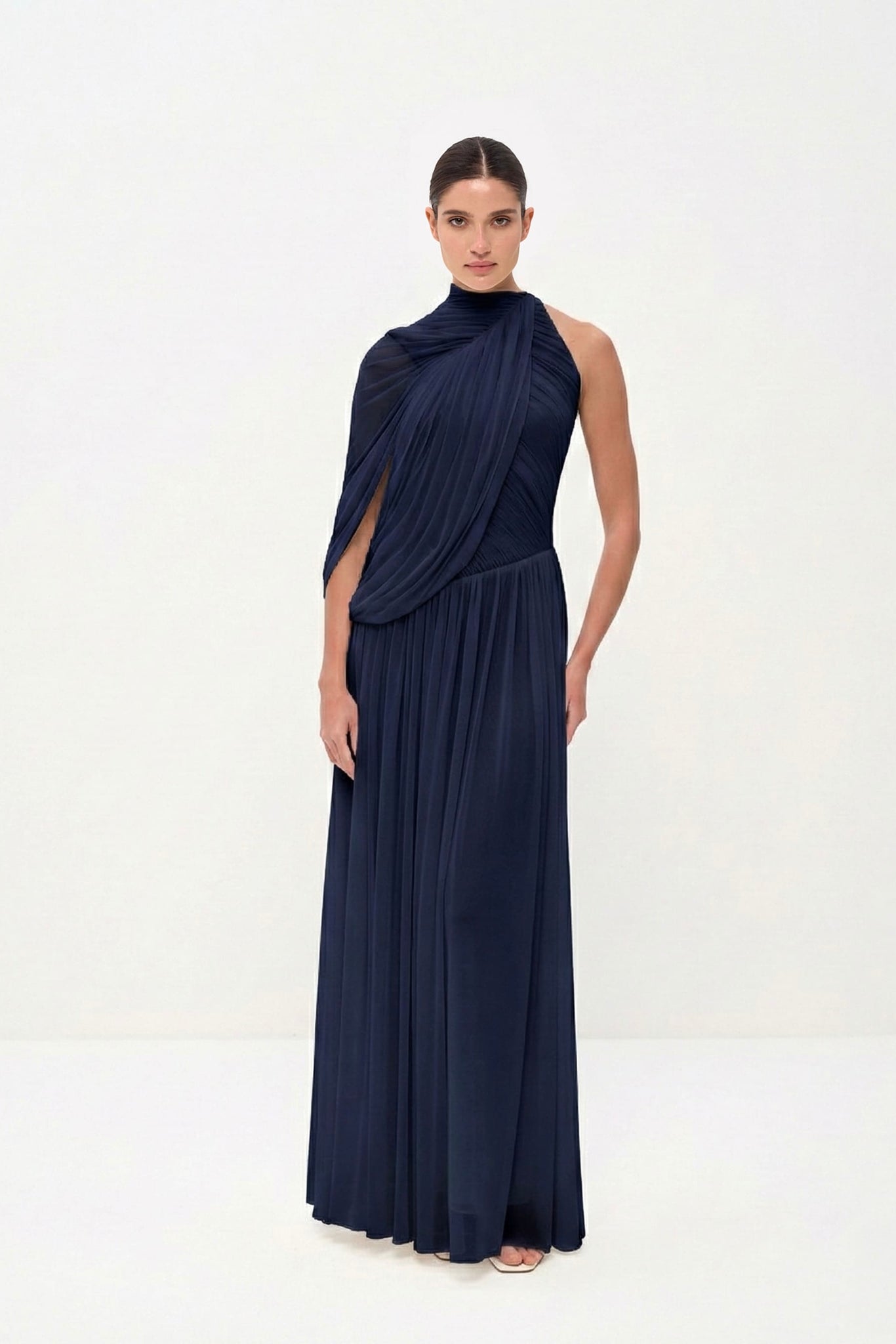
When I finally let go of that silk dress I mentioned, I replaced it with a soft jersey gown, something like the Adelie Pleated Gown, that does everything the old dress used to do but fits my current life more honestly. I can wear it to dinner at Scalini. I can wear it to a Friday lunch. It travels well. (The kind of dress you pack first and reach for most.) That versatility is what replacement should actually feel like. Not accumulation. Upgrade.
The Dubai Factor
Living here adds a specific dimension to this whole conversation. Dubai's climate is uncompromising on fabric. Pieces made from synthetics that don't breathe will deteriorate faster, both in structure and in how they feel against your skin. The constant transition from outdoor heat to indoor air conditioning tests every seam, every closure, every drape.
I've noticed that the pieces I repair most often are the ones made from natural or semi-synthetic fibers. They hold up. They respond well to a tailor's work. The pieces I end up replacing tend to be the ones where the fabric itself was the weak link from the start.
This is worth thinking about when you do replace something. Choose a fabric that will age with grace rather than fall apart after two seasons. Bamboo jersey, viscose knit, TENCEL lyocell, Naia satin. These aren't just nice-sounding names. They're materials that respond to the specific demands of dressing in this city.
Something like the Eliane Asymmetrical Gown in Naia Satin was designed to be worn and worn again, through Dubai winters, through air-conditioned restaurants, through mornings that turn into evenings. That kind of longevity is what makes a replacement feel like a resolution rather than a repeat.

A Simple structure for the Decision
I've started asking myself four questions whenever I pull something from my closet.
First: is the problem something I'm able to fix in under a week for a reasonable cost? If yes, take it to the tailor tomorrow. Not next month. Tomorrow. The longer a repair waits, the less likely it gets done.
Second: do I still love the fabric, the color, the idea of this piece, but the fit has drifted? Then explore alteration. Talk to a tailor about what's possible before you decide it's not worth it.
Third: have I been keeping this piece out of obligation rather than desire? Be honest. If it's been more than six months since you wore it, and it's not eveningwear you're saving for a specific occasion, the obligation is likely stronger than the desire. Let it go with gratitude, not guilt.
Fourth: if I replace it, can I articulate exactly what the replacement needs to do? "I need a dress I can wear to dinner and to Friday brunch and that travels without wrinkling" is a clear brief. "I just want something new" is not. Replace with purpose. Otherwise you're just adding.
Building a Closet That Doesn't Need Constant Editing
The long game here isn't about getting better at the repair-alter-replace decision. It's about needing to make that decision less often.
That means buying fewer things, but buying them with more care. Paying attention to fabric weight, to how a garment moves, to whether the construction feels like it'll hold up after thirty wears or just three. It means understanding that a well-made dress at a thoughtful price point will almost always outlast two cheaper alternatives, in both durability and how long you'll want to wear it.
It also means accepting that your wardrobe will evolve. Slowly. In small adjustments. A hem taken up here, a new piece added there, an old favorite passed along when its time has come. This is what a healthy closet looks like. Not frozen, not frantic. Just cared for.
The women I admire most, the ones who always seem to look right without appearing to have tried too hard, tend to have smaller wardrobes than you'd expect. They know their tailor. They know their fabrics. They invest in co-ord sets and dresses that do more than one thing well. And they're not sentimental about letting go when something has run its course.
That clarity is quieter than any shopping spree. And it looks so much better.