


How to Accessorize a Simple Dress Without Overdoing It
The best-dressed women I know in Dubai wear fewer accessories than you'd expect. Here's how to accessorize a simple dress without overdoing it.
I had dinner at Scalini last month with a friend who looked absolutely perfect. Black viscose knit dress, gold hoops, one ring, flat sandals. That was it. She walked in and the hostess complimented her. A woman at the next table asked where her dress was from. Nothing about her outfit was complicated, but every detail felt considered. The whole thing worked because she hadn't added anything that didn't earn its place.
That's the real question with accessories. Not what to add. What to leave alone.
Why Simple Dresses Are Actually Harder to Accessorize
There's a common assumption that a simple dress is a blank canvas, and that your job is to fill it. Pile on the jewelery. Add a statement bag. Choose the boldest shoes you own. This thinking is everywhere online, and it almost always leads to an outfit that feels overdone.
The truth is closer to the opposite. A simple dress has a clarity to it. A clean neckline, a single color, a fabric that moves well. When you add too much, you interrupt that clarity. The dress stops being the point. Your accessories start competing with each other instead of supporting the whole picture.
I've seen this happen at weddings, at gallery openings in Alserkal, at brunches along the Marina. Someone starts with a beautiful dress and then adds a chunky necklace, a printed scarf, stacked bangles, and statement earrings. Each piece is lovely on its own. Together, they cancel each other out.
The goal isn't to decorate yourself. It's to finish the thought the dress already started.
Start With the Neckline, Not the Jewelery Box
This is where most people go wrong. They pick their jewelery first. But the dress should tell you what it wants.
An off-shoulder neckline, like the Aria Off-Shoulder Dress in Naia satin, already has architecture. The exposed collarbone is the detail. A heavy necklace would compete with that. Small earrings and a single bracelet would be more than enough.

A high neck dress, on the other hand, closes off the chest entirely. That's where earrings become your primary accessory. Something that catches light near your face without adding visual weight. Drop earrings, not chandeliers.
A V-neck invites a pendant. A crew neck works with a layered chain. A halter asks for almost nothing except maybe a cuff on the wrist.
Look at the dress before you open a single drawer. Ask yourself: where does the eye already go? Then put your one best accessory somewhere else.
The Principle of One Focal Point
Forget the 3-3-3 rule or the 5-5-5 rule. Those structures treat getting dressed like a maths problem. Real style doesn't work that way.
What works, in my experience, is simpler: choose one focal point per outfit. One thing that draws attention. Everything else should be quiet enough to let that one thing land.
If your focal point is the dress itself (a beautiful drape, an unusual color, a fabric with presence), then your accessories should be minimal. Small earrings. A clean watch. Shoes in a tone that doesn't pull focus.
If your focal point is an accessory (a bag you love, a pair of earrings with real personality), then the dress needs to step back. Something solid-colored, well-cut, uncomplicated. The NÓRA dresses collection is full of pieces that do exactly this, dresses with enough polish to hold up on their own but enough restraint to let your accessories breathe.
One focal point. That's it. The discipline is in choosing which one.
How to Make a Simple Dress Look Elevated
There's a difference between a simple dress and a plain one. A simple dress has intention in its cut, its fabric, its proportions. A plain dress just happens to have nothing going on.
If you're starting with quality (the right fabric, a good fit), then elevation is about precision, not addition. Here's what I've seen work consistently in Dubai, where the light is strong and the rooms are air-conditioned and the margin between polished and overdone is genuinely thin.
Shoes with a point of view. Not necessarily heels, but shoes that look chosen rather than grabbed. A leather mule, a strappy flat, a heel with a clean silhouette. The shoe should feel like it belongs to the same woman who picked the dress.
One piece of gold. A fine chain, a signet ring, a pair of hoops. Gold reads well against most skin tones and most fabrics. It adds warmth without weight. In Dubai, where so much of our social life happens under indoor lighting, gold catches light in a way that feels natural rather than performative.
A bag that doesn't try to upstage you. The bag is the accessory that most often tips an outfit into "too much" territory. A clutch in a complementary tone is almost always the right move with a simple dress. Save the logo bags for jeans and a t-shirt, where they have room to make a statement.
Accessories That Work in Dubai's Climate
Climate matters more than most style guides acknowledge. We wrote about this in more detail in our guide to what to wear in Dubai, but the short version: your accessories need to feel good in 40-degree heat and 20-degree air conditioning, sometimes within the same hour.
Heavy metal jewelery absorbs heat quickly. A thick chain necklace that felt fine in the car will feel warm against your skin the moment you step outside to walk from the valet to the restaurant door. Lighter pieces, thinner chains, smaller earrings, these are more practical and more comfortable.
Leather bags and belts hold up well in both environments. Beaded bags, woven clutches, and fabric accessories can feel heavy or damp in humidity. Know what your accessories are made of. It matters just as much as knowing your dress fabric.
Scarves are interesting. A silk scarf tied loosely at the neck or wrist can add color to a neutral dress. But in the summer months here, anything wrapped around the neck can feel suffocating by the second course. I'd save scarves for November through March and use earrings to add color the rest of the year.
The Mistake of Matching Too Carefully
There's a version of "done" that looks too done. When your bag matches your shoes matches your belt matches your earrings, the outfit starts to feel like a costume. Everything is coordinated, but nothing feels personal.
The most intentional stylist I know let one thing be slightly off. Silver earrings with a gold ring. A brown bag with black shoes. A warm-toned dress with cool-toned jewelery. These small tensions make the outfit look like it belongs to a real person who got dressed with confidence, not from a matching set on a mannequin.
The same applies to sets, by the way. A beautifully made set, like the ones in the NÓRA sets collection, already has its coordination built in. The top and skirt or top and trouser were designed together. That means your accessories can afford to introduce a small contrast. A different texture, an unexpected colour, a piece that feels like it came from a different mood. The set does the heavy lifting of looking put-together. Your accessories get to be the thing that makes it yours.
When to Wear Nothing at All
I want to say something that might sound strange in a post about accessorising: sometimes the right answer is no accessories at all.
A dress with a strong silhouette, a fabric that catches light on its own, a colour that's doing all the work, sometimes adding anything to that is just noise. The Enza Pleated Gown in soft jersey, for example, already has a distinct silhouette. It doesn't need a necklace to announce itself. Bare ears, bare wrists, a simple shoe. Done.
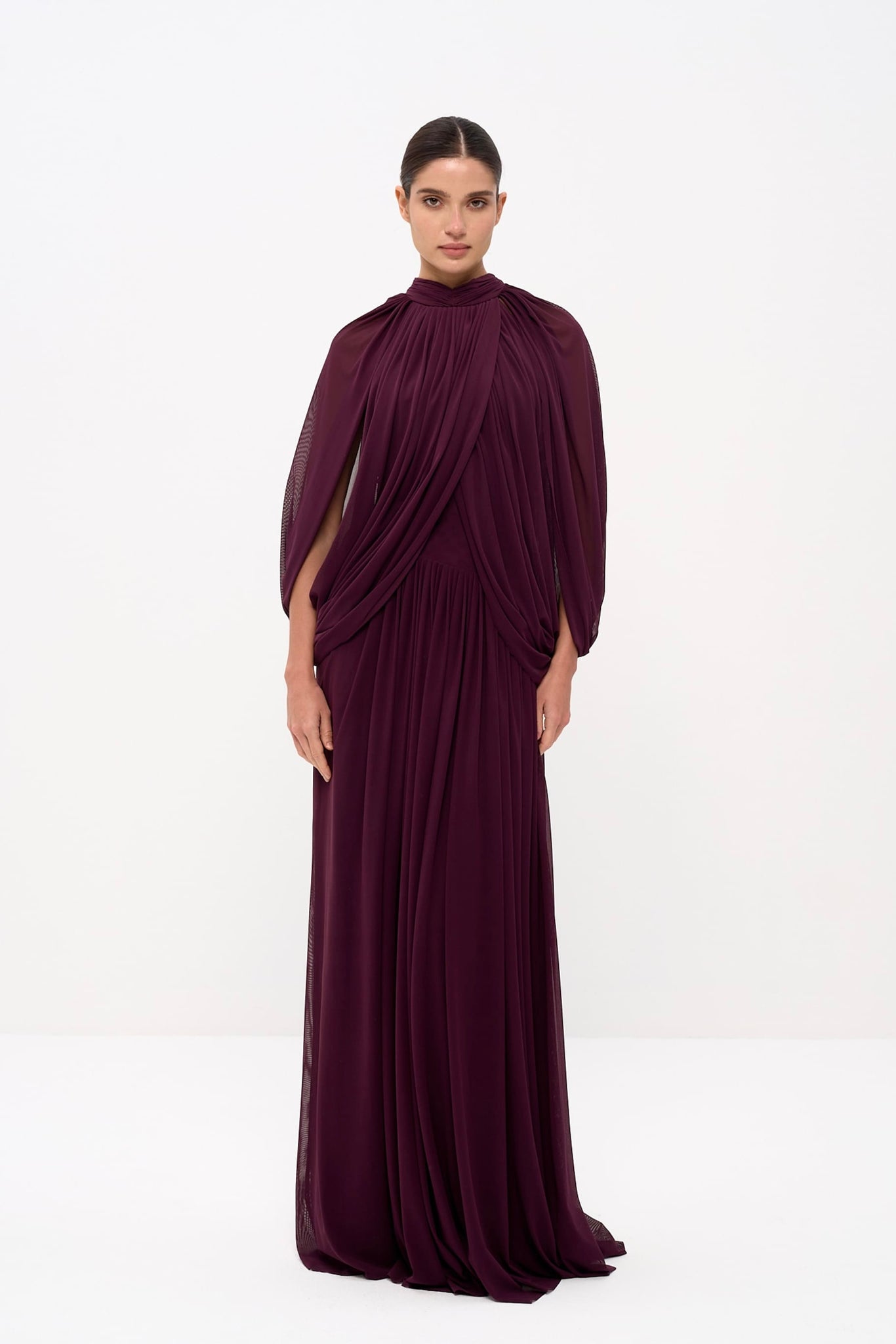
There's a confidence in wearing nothing extra. It says you trust the outfit. You trust yourself. You don't need a safety net of accessories to feel finished.
I think the best-dressed women know when to stop. They put something on, look in the mirror, and instead of adding one more thing, they take one thing off. That instinct is worth more than any rule.
A Quick Checklist (For When You're Running Late)
Because sometimes you have fifteen minutes before the car arrives and you need a structure, not a philosophy.
Look at the neckline. Let it tell you where jewelery goes (or doesn't).
Pick one focal point. If the dress is the star, accessories stay quiet. If an accessory is the star, the dress stays simple.
Limit yourself to two jewelery zones. Ears and wrist. Neck and fingers. Not all four at once.
Check the proportions. Delicate dress, delicate jewelery. Structured dress, slightly bolder pieces. They should speak the same language.
Look at your reflection from across the room, not just up close. What reads from a distance? If you can see six different things competing for attention, edit.
Remove one thing. Whatever you added last, take it off. See if the outfit improves. It usually does.
What Confidence Actually Looks Like
I keep coming back to my friend at Scalini. Gold hoops, one ring, flat sandals. She wasn't under-dressed. She was precisely dressed. Every choice was purposeful. Nothing was there by accident or out of anxiety.
That's what knowing how to accessorize a simple dress without overdoing it really means. It's not about following a formula. It's about having enough trust in your choices to leave space. The empty wrist, the bare neck, the shoe that doesn't shout. Those quiet decisions are what separate "she's wearing a nice outfit" from "she looks incredible."
The women I admire here in Dubai, the ones who always seem to get it right, they share a specific habit. They dress like they have nothing to prove and nowhere to hide. Their clothes fit. Their accessories are few but considered. And when they walk into a room, what you notice first is them, not their jewelery.
That's the whole point.
If you're starting with the right dress, the kind that already has intention in its fabric and its cut, then accessories become the smallest, most satisfying part of getting ready. Start there. The rest is just editing.