


Skin Comfort Is a Sustainability Question
If a fabric irritates your skin by noon, you won't wear it again. That's waste. And that's why skin comfort belongs in the sustainability conversation.
Most of the sustainability dialogue in fashion circles around the same few talking points: recycled packaging, carbon offsets, organic cotton certifications and supply chain transparency. All of it matters. But there's a piece of the conversation that rarely gets attention, and it's the one closest to your body. Literally on it. How a fabric feels against your skin, hour after hour, determines whether that piece stays in your life or ends up forgotten at the back of your closet.
A forgotten garment is, by any honest measure, an unsustainable one.
The garment you actually wear is the sustainable one
I've been thinking about this since a friend told me she'd donated four dresses in one weekend. All relatively new. All purchased with good intentions. Two were linen that wrinkled so aggressively she felt undone by lunchtime. One was a polyester blend that trapped heat in a way she described as "punishing." The fourth was beautiful on the hanger but had a neckline that left red marks on her collarbone.
None of these dresses had sustainability problems on paper. Some even had the certifications to prove it. But she wore each of them once, maybe twice, and then moved on.
Four dresses, four rounds of production, shipping, and raw materials, all functionally wasted because they didn't feel right on a human body in a real day.
This happens constantly. And it happens more in warm climates like Dubai, where the gap between how something looks on a model and how it performs on your skin at 2pm in June is enormous.
A dress that doesn't breathe here doesn't get a second chance. Step into any restaurant in DIFC and it's winter, instantly. Walk back outside and you're in full summer.
Your clothes have to handle both without making you conscious of what you're wearing. The moment you start adjusting, pulling, or regretting a fabric choice, that piece has failed its most basic job.
Why the sustainability conversation stopped at the factory door
There's a reason comfort rarely comes up in sustainability discussions. It's hard to measure. You can quantify water usage per meter of fabric. You can calculate carbon emissions in a supply chain. You can count the percentage of recycled content in a fiber. But you can't easily put a number on how something feels against someone's inner arm on a warm afternoon.
So the industry focuses on what it can measure, and comfort becomes a marketing word instead of an environmental one. Brands describe their clothes as "soft" or "luxurious" in product copy, but they don't connect that softness to the larger question of whether a garment will actually be worn enough to justify its existence.
That connection matters more than most people realize. The Ellen MacArthur Foundation published research showing that extending the active life of a garment by just nine months reduces its environmental impact by 20 to 30 percent. Nine months. That's the difference between a dress you reach for regularly and one that sits untouched after a single outing because the fabric felt wrong.
If we're serious about sustainability, we have to be serious about what makes someone want to wear a piece again, and again next year. That starts with how it feels.
What "skin comfort" actually means in fabric terms
Skin comfort isn't just about softness, though softness matters. It's about a cluster of properties that determine whether a fabric works with your body or against it: breathability, moisture management, thermal regulation, drape weight, and surface friction. A fabric that scores well on all of these disappears against your skin. You stop noticing it. That's the goal.
Synthetic fabrics, particularly polyester, tend to struggle here. They don't absorb moisture well. They hold heat. They can create that slightly sticky feeling that makes you want to change the moment you get home. This is why fast fashion's reliance on polyester is a double problem: the fabric is petroleum-based and slow to decompose, and the garments made from it are often uncomfortable enough that people cycle through them quickly. The environmental cost compounds.
Fibers like TENCEL lyocell, bamboo jersey, and Naia satin occupy a different space. TENCEL, made from sustainably sourced wood pulp, has a moisture absorption rate greatly higher than polyester. It breathes.
Bamboo jersey is naturally thermoregulating, which means it responds to your body temperature rather than fighting it. Naia satin, derived from wood pulp through a closed-loop process, has a surface texture that feels cool and clean against skin without the cling that petroleum-based satins develop in heat.
These aren't exotic, hard-to-find materials. They're more and more available. The question is whether brands prioritize them, or whether they default to cheaper synthetics that look fine in a photograph but perform poorly on a person.
Dubai taught me how fabric honesty works
Living in Dubai recalibrates your relationship with clothes in ways that are hard to explain to someone in a temperate climate. You learn fast. A restaurant dinner at Scalini might be perfectly air-conditioned, but the walk from the valet to the door in August will tell you everything about your outfit's fabric composition. You have maybe ninety seconds. That's enough.
I've noticed that the women here who consistently dress well tend to have smaller, more considered wardrobes. They've edited through experience. They know which fabrics hold up through a full Dubai day, from morning school drop-off through a work lunch through an evening with friends, and they build around those fabrics. It's an instinctive form of sustainability, even if they'd never use that word.
Something like the Cyria Gown in Viscose is a good example of this principle in practice. The fabric is light enough for outdoor warmth but has enough weight to drape properly in cold interiors. It doesn't wrinkle in the way that makes you self-conscious after sitting for two hours. It's the kind of piece that quietly earns repeat wears because it doesn't create problems. (And a dress that creates no problems is rarer than you'd think.)
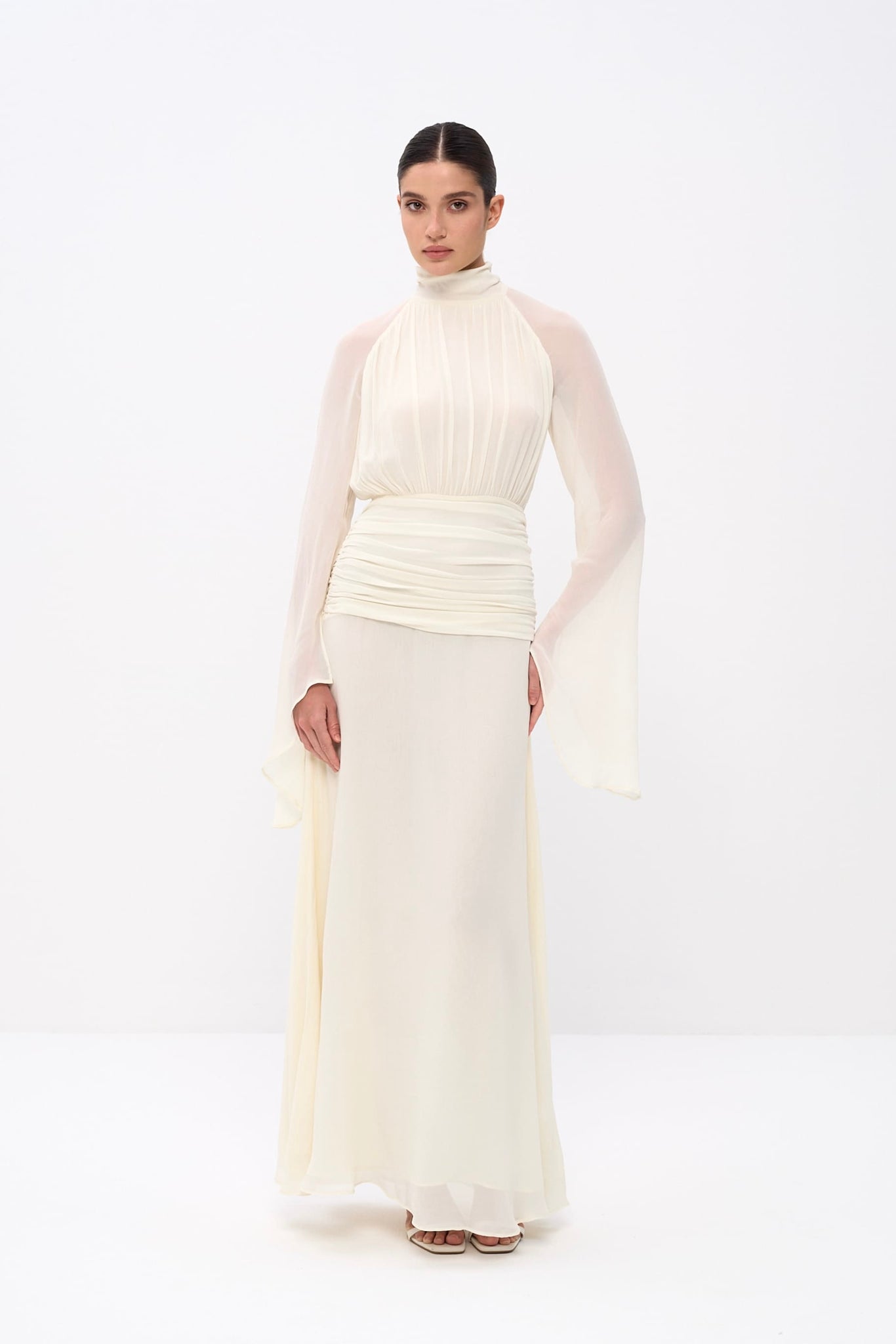
We covered some of this territory in our guide to what to wear in Dubai, but the sustainability angle is worth pulling out separately. Because the same fabric choices that make a garment comfortable in this climate also tend to make it more environmentally responsible, and more likely to be worn for years.
The cost-per-wear equation that no one talks about
There's a phrase in fashion, "cost per wear," that's usually invoked to justify buying something expensive.
The logic is simple: a dress that costs AED 800 and gets worn forty times costs AED 20 per wear.
A dress that costs AED 200 and gets worn twice costs AED 100 per wear. The expensive dress was the better deal.
What people rarely acknowledge is that comfort is the single biggest factor in whether something gets worn forty times or two times. Not trend. Not color. Not even fit, though fit matters. Comfort. Because fit issues you might tolerate. A color that's slightly off, you might style around. But a fabric that irritates your skin or traps heat or feels heavy in the wrong way? You'll avoid it without even making a conscious decision. It just stops appearing in your rotation.
This is where sustainability and personal experience converge. The most sustainable garment in your closet is the one you reach for most. And the one you reach for most is almost always the one that feels best. The environmental argument and the personal argument are the same argument.
Viscose knit and the case for fabric intelligence
I want to talk about viscose knit specifically, because it illustrates something important. Viscose has been around for over a century. It's not new technology. It's not a breakthrough. But when it's knitted well, in the right weight, with good finishing, it does something that most fabrics can't: it moves with you without losing its shape, it breathes without feeling insubstantial, and it recovers from being packed in a suitcase without looking like it was packed in a suitcase.
The Asteri Dress in viscose knit is the kind of set that makes this tangible. You can wear it to a meeting at your office in Business Bay, have a late lunch at Zuma, and still feel put together at 6pm.
The fabric doesn't deteriorate over the course of a day the way thinner materials do. It holds up. And because it holds up day after day, week after week, it stays in your closet actively, doing its job, rather than drifting toward that section in the back where good intentions go quiet.

Fabric intelligence, choosing materials for how they perform rather than just how they look, is the least discussed and most impactful sustainability decision a brand can make. It's also the least discussed and most impactful decision a customer can make. Every time you buy something that feels genuinely good on your body, you're more likely to wear it until it wears out. That's the whole game.
Why certifications alone aren't enough
I want to be careful here, because certifications are valuable. OEKO-TEX, GOTS, FSC, these standards do real work. They hold supply chains accountable. They give consumers information they wouldn't otherwise have. But a certification tells you about how a fabric was made. It doesn't tell you how it will live.
A perfectly certified organic cotton dress that's too stiff for your daily life still ends up unused. A responsibly produced linen top that wrinkles beyond what you're willing to manage on a workday still gets left behind. The garment's afterlife, the months and years of actual wearing, is where most of its environmental impact is determined. And that afterlife depends, more than anything, on whether the person who owns it finds it comfortable enough to keep reaching for.
This is the missing piece. Sustainability structures need to account for wearability. For real, lived, skin-level comfort. Not as a luxury feature or a marketing claim, but as an environmental factor with measurable consequences.
A different way to think about your closet
Try this. Open your wardrobe and look at what you've worn in the last two weeks. Pull those pieces forward. Now look at what's been untouched for a month or more. The patterns are usually clear. The pieces you wear are the ones that feel right. The ones you avoid are the ones that looked right in the fitting room but didn't translate to your actual life, your actual body temperature, your actual schedule.
If you built a wardrobe entirely around skin comfort, choosing fabrics that breathe and drape and regulate temperature and feel good after eight hours, you'd likely end up with fewer pieces. You'd also end up with less waste, less guilt, and less of that low-grade closet anxiety that comes from owning things you don't wear but feel you should.
That's sustainability at its most personal and its most practical. Not a campaign. Not a label on a tag. Just clothes that work so well against your skin that you never want to replace them.
Where this leaves us
The fashion industry will keep talking about water usage and carbon footprints and recycled content, and it should. Those conversations matter. But until comfort is part of the sustainability conversation, honestly and specifically, we'll keep producing garments that check every environmental box except the one that determines whether they actually get worn.
A dress in bamboo jersey that someone wears every other week for three years has a fundamentally different environmental footprint than a dress in certified organic polyester that someone wears once and quietly abandons. The numbers aren't close. And the difference between those two outcomes almost always comes down to how the fabric felt on skin.
If you're rethinking your own wardrobe along these lines, NÓRA's new arrivals are a good place to start feeling the difference. Everything is built around fabrics that are chosen for how they live on a body, not just how they photograph. The kind of pieces that earn their place by being the ones you always reach for first.