


What Naia Satin Actually Is (And Why It Feels Different)
If you've touched Naia satin and thought it felt nothing like the satin you knew, you're right. Here's what it is, where it comes from, and why it matters.
The satin you grew up with probably wasn't satin
Most of us learned the word "satin" from a bridesmaid dress or a pillowcase. Something shiny, a little slippery, and almost always synthetic. That's the version that dominates fast fashion and department store racks. It photographs well. It wrinkles the moment you sit down. And after two hours in it, you understand why the word "breathable" exists, because the fabric you're wearing is the opposite.
Here's what gets lost in the marketing: satin is a weave, not a material. It's a specific way of interlacing threads so the surface catches light. You can weave satin from silk. From polyester. From cotton. The weave gives you the sheen. But what determines how the fabric actually feels, how it moves, how it behaves against your skin in 38-degree heat, is the fiber itself.
And that's where everything changes.
So what is the composition of Naia satin?
Naia is a cellulosic fiber made from wood pulp. Specifically, it comes from sustainably managed pine and eucalyptus forests. The fiber is produced by Eastman, a materials company that's been around for over a century, using a closed-loop process that recycles solvents and reduces waste.
The technical name is acetate, but calling Naia "acetate" is a bit like calling cashmere "goat hair." Accurate, and yet completely beside the point.
What matters is what happens after the chemistry. Naia fibers are woven into a satin construction, and the result is a fabric that has the luminous surface of traditional satin but none of the baggage.
It drapes differently. It breathes. It doesn't cling to your legs when you walk from the car to the restaurant. It doesn't develop that damp, plasticky feeling that polyester satin does the moment your body temperature rises.
I first noticed the difference at a Friday lunch at Scalini. I was wearing a Naia satin piece, and the air conditioning was doing its usual aggressive thing. The fabric stayed comfortable. Later, walking to the valet in full sun, it still felt fine. That dual-climate performance is the thing nobody talks about, and it's the thing that matters most if you actually live here.
What satin is supposed to feel like
Real satin, the kind woven from natural or semi-natural fibers, should feel cool to the touch. It should skim your body, not grip it. It should move when you move, with a slight weight that gives it presence. You should be able to sit, stand, walk, and get in and out of a car without the fabric riding up or bunching.
Polyester satin does about half of that. It looks the part. The sheen is there. But the hand feel is off. There's a stiffness, a slight resistance, like the fabric is fighting you.
And polyester doesn't manage moisture. It traps heat against your skin and holds it there. In a temperate climate, you might not notice. In Dubai, you notice immediately.
Naia satin feels closer to silk satin than anything else I've worn at this price point. There's a softness that's hard to describe without sounding like a press release, so I'll just say this: you don't adjust it.
You put it on and forget about it. That forgetting is the whole point. The best fabrics disappear. You stop thinking about what you're wearing and start thinking about where you're going.
Is 100% polyester still satin?
Technically, yes. If it's woven in a satin construction, it's satin regardless of the fiber.
Polyester satin has its place. It's inexpensive to produce, widely available, and holds color well. For a costume, a lining, a decorative throw pillow, it works. But for clothing you wear against your skin, in a city where the temperature regularly exceeds 40 degrees, the limitations are real.
Polyester is a petroleum-based synthetic. It doesn't biodegrade. It doesn't breathe in any meaningful way. And it generates microplastics every time you wash it. None of this makes it evil, but it does make it a compromise. The question is whether you're making that compromise knowingly.
Naia, by contrast, is biodegradable. It comes from renewable wood sources. And because it's a cellulosic fiber, it has a natural affinity for moisture, wicking it away from the skin rather than sealing it in. The difference is functional, not just philosophical.
Why Naia works in this climate
Dubai's style has its own rhythm. We dress for temperature swings that happen in seconds, the walk from a 45-degree parking lot into a 19-degree restaurant. We layer not for warmth but for versatility. And we need fabrics that hold their shape through a full day that might start with school drop-off and end at a dinner in DIFC.
Naia satin handles all of this quietly. It doesn't wrinkle the way polyester satin does (that stiff, angular creasing that looks careless rather than relaxed). It doesn't lose its drape after a few hours. And it has a weight to it, just enough, that gives structure without stiffness. A dress in Naia satin looks composed at 7 AM and still looks composed at 11 PM.
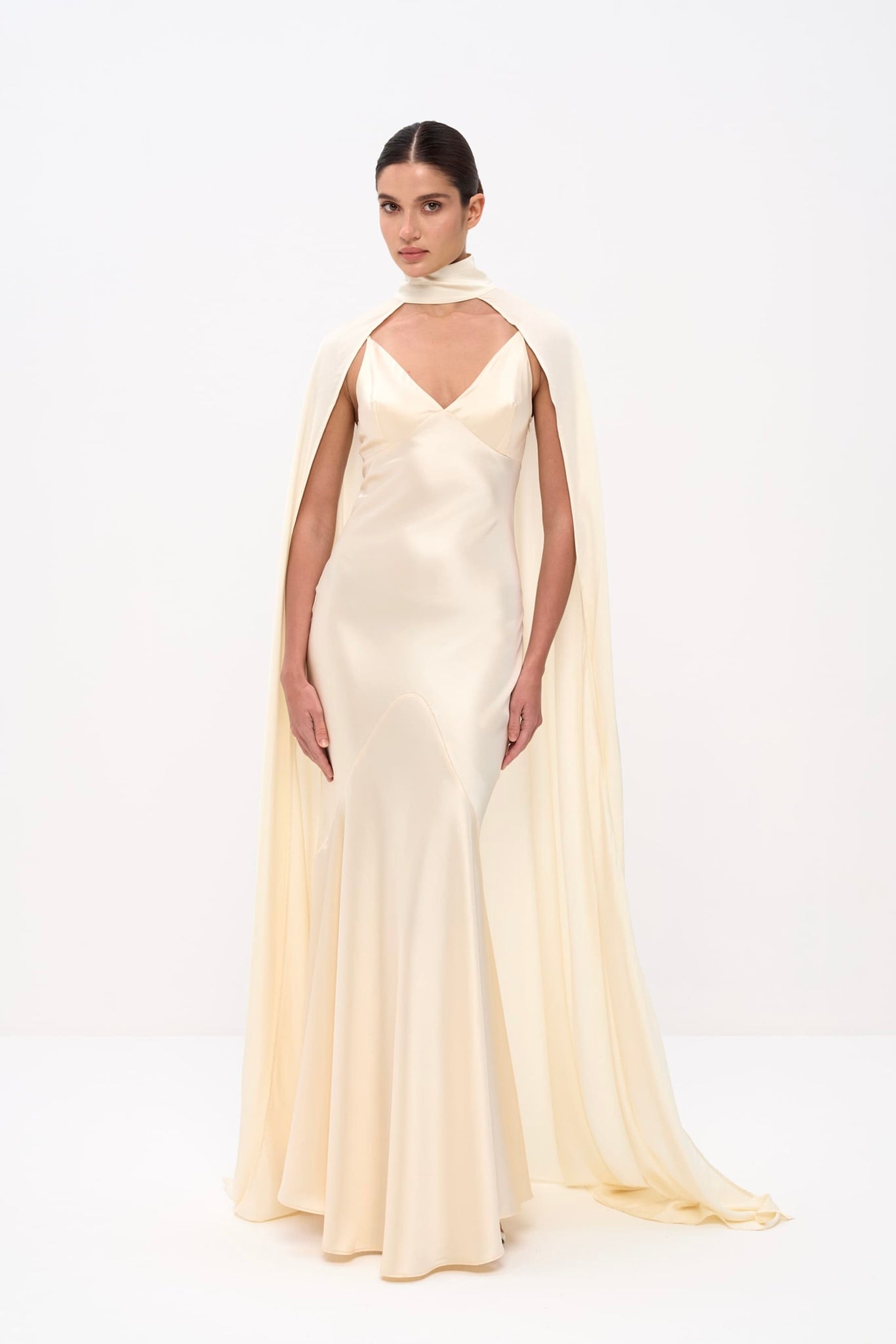
The Siora Cape Gown is a good example. It's cut with a cape detail that moves beautifully in Naia satin because the fabric is fluid enough to float but substantial enough not to fly away in every breeze. In polyester satin, that same cape would either hang limp or catch static and cling to your arms. The fabric choice makes the design possible.

How Naia satin photographs
This might sound like a shallow concern, but it isn't. If you're getting dressed for an event, a wedding, an evening out, a celebration where someone will inevitably point a phone at you, the way your clothes catch light matters.
Polyester satin has a flat, almost metallic sheen. It bounces light harshly. In flash photography, it can look wet.
Naia satin has a softer luminosity. The sheen is there, but it's warmer, more dimensional. It reads well in both natural light and artificial light, which is why it works equally well for an outdoor sunset reception and a candlelit dinner at Zuma. The surface has depth to it. It catches light without reflecting it back like a mirror.
I've seen this play out in real time. At a wedding last winter, two guests wore similar-colored gowns, one in polyester satin, one in Naia. The difference in photos was striking. The Naia piece looked like it had been professionally lit.
The polyester piece looked like it was trying too hard. Same color, same silhouette, completely different impression.
Which type of satin is best?
It depends on what you're asking it to do. Silk satin is gorgeous. It has been gorgeous for centuries. But it's fragile, expensive to maintain, and stains if you look at it wrong. (I once lost a silk blouse to a single drop of salad dressing. Still think about it.)
For everyday luxury, silk requires more devotion than most of us are willing to give.
Polyester satin is durable and affordable. It holds up to washing and doesn't wrinkle easily when hung. But it doesn't breathe, it doesn't drape with the same grace, and it has a limited lifespan before it starts to pill and lose its surface quality.
Naia satin sits in the space between them. It has the beauty of silk, the practicality of something you can actually wear repeatedly without anxiety, and the added benefit of being biodegradable. It's not the cheapest option. It's the most considered one.
Something like the Roisin Shirt & Pants in Naia satin shows how the fabric translates beyond gowns. It's a set you could wear to a Friday brunch, then to an afternoon gallery opening in Al Quoz, without changing. The satin gives it polish. The Naia fiber gives it comfort through both.

The care question
People ask about this a lot, and fairly. Beautiful fabric that falls apart after two washes isn't beautiful. It's frustrating.
Naia satin holds up. It can be hand washed or dry cleaned, depending on the garment construction. It doesn't shrink the way some natural fibers do, and it resists the pilling that plagues polyester over time. The color stays true wash after wash because cellulosic fibers absorb dye differently than synthetics. The hue deepens into the fiber rather than sitting on top of it.
I have Naia satin pieces that are over a year old and still look the way they did when I first took them out of the garment bag. That longevity matters, especially when you're investing in something you want to wear again and again. (The kind of piece you pack first and reach for most.)
The sustainability part, without the lecture
You've heard the sustainability pitch from every brand by now. Some of it is genuine. Some of it is marketing wrapped in recycled packaging.
I'm not going to tell you that buying a Naia satin dress will change the world. But I will say this: the fiber is derived from responsibly sourced wood, produced in a closed-loop process, and it biodegrades at the end of its life.
That's a meaningfully different lifecycle than petroleum-based polyester, which will outlast you, your children, and probably their children too.
We covered the broader fabric question in our guide to what to wear in Dubai, but the short version is that fabrics designed for this climate tend to also be fabrics that are gentler on the planet.
Breathability and biodegradability often go hand in hand. Nature figured that out a long time ago.
Why the fiber matters more than the weave
The fashion industry has spent decades selling us on surface. Sheen, color, pattern, silhouette. All of that matters, of course. But the fiber is the foundation.
It determines how a garment behaves in your real life, not on a hanger, not in a photo, but on your body, in your climate, through your day.
Understanding what Naia satin actually is and why it feels different from satin made of other fibers isn't about being a fabric nerd. It's about making better choices with your time and money. When you know that the satin weave is just the surface and that the fiber underneath is doing all the real work, you start shopping differently. You start asking what something is made of before you ask what it looks like.
And once you do that, the things you bring home tend to stay in rotation much longer.
The Iliana Gown is a piece I keep coming back to as an example of what Naia satin can do. The cape, the drape, the way it moves, all of that is possible because the fabric cooperates with the design rather than working against it. You can see it in the way the hem falls. Clean, fluid, unhurried.
If you're curious about how Naia satin looks in person, across different silhouettes and color-ways, NÓRA's dress collection and sets have a good range to explore. Some things, like the hand feel of a fabric or the way it catches afternoon light through a restaurant window, you really do have to see for yourself.