


Viscose vs Polyester: Drape, Heat, and Truth
If you've ever wondered about viscose vs polyester for dresses, which one drapes better and traps less heat, the answer is simpler than the internet makes it sound.
I wore a polyester dress to a Friday brunch at Scalini last March. It was a nice dress. Good cut, flattering color, the sort of thing that photographs well. By the time I walked from the valet to the door, maybe forty seconds in the sun, I could feel the fabric clinging to my lower back. Inside the restaurant, it took a full fifteen minutes for that damp, sealed-in feeling to pass. The air conditioning did its job, eventually. But the fabric never really let go of what it had trapped.
Two weeks later, same kind of occasion, different dress. Viscose knit. I don't remember thinking about the fabric at all, which is exactly the point.
What Actually Happens When Fabric Meets Heat
Most comparisons between viscose and polyester focus on fiber composition, which matters, but not in the way technical articles make it sound. Here's what matters if you live somewhere warm. Or if you travel somewhere warm. Or if you spend any amount of time moving between air-conditioned rooms and actual sunlight, which in Dubai is roughly every hour of every day.
Polyester is a plastic-based fiber. It's durable, it holds dye well, and it resists wrinkling. These are real advantages. But plastic doesn't absorb moisture. It moves it along the surface (the industry calls this "moisture-wicking"), and in athletic wear, where the goal is fast evaporation during intense activity, this works. In a dress, at a dinner, the equation is different. You're not generating enough movement for that wicking to activate properly. You're sitting, walking, maybe dancing a little. The moisture stays close to your skin, and the fabric forms a kind of warm layer between you and the air. That sealed feeling isn't imagined. It's physics.
Viscose is derived from plant cellulose, usually wood pulp. It absorbs moisture, genuinely absorbs it, up to about 13% of its weight before it starts to feel damp. It breathes. And because it breathes, it releases heat instead of holding it against you. When you step from the car into a restaurant, the transition is smoother. Your body adjusts. The fabric adjusts with it.
This might sound like a small thing until you've lived it over a full evening.
The Drape Question, Honestly
Drape is one of those words that gets used loosely. What it actually means is how fabric falls under its own weight, how it responds to gravity and to the curves of your body. Good drape is the difference between a dress that moves with you and a dress that holds its own shape regardless of what you're doing. Both have their place. But for most occasions, most silhouettes, most women, you want movement.
Polyester can be engineered to drape. Higher-end polyester satins and crepes do fall nicely, and I won't pretend otherwise. But the drape tends to be surface-level. It looks right in a mirror or a photo, then feels stiff when you sit down or cross your legs. There's a slight resistance, a memory in the fabric that pulls it back toward its original shape. Fine for structured pieces. Less fine for anything that's supposed to feel fluid.
Viscose drapes with genuine weight. It follows the body without gripping it. When you walk, it swings slightly behind you, then catches up. When you sit, it pools rather than bunching. This is why viscose has been a favorite of designers who work with bias cuts and draped silhouettes for decades. The fabric cooperates.
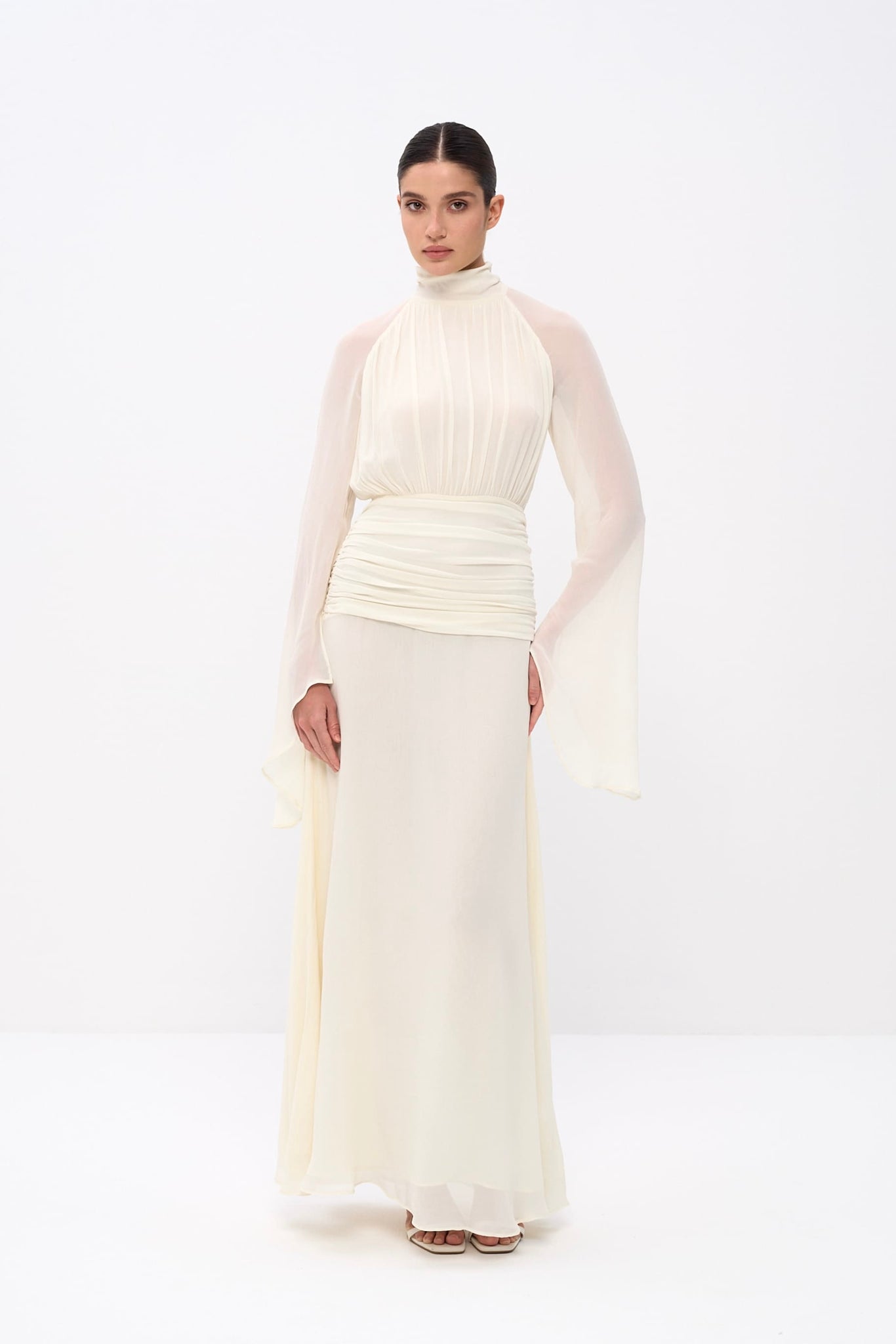
A piece like the Cyria Gown in viscose is a good example. The pleating holds its structure, but the fabric itself is soft enough to move with your body rather than against it. That combination, structured detail with fluid fabric, is hard to get right in polyester without adding weight or lining.
Is Viscose or Polyester Better for Hot Weather?
Polyester is better for situations where you need the garment to hold up under extreme conditions: heavy rain, repeated washing, extended outdoor activity. If you're hiking in humidity, polyester athletic wear makes sense. If you're dressing for a wedding in June, it doesn't.
Viscose is better for hot weather dressing in nearly every social context. Dinners, brunches, work, travel, events. It breathes. It absorbs. It cools. And it does all of this while looking refined, which is the part that technical fabric comparisons tend to skip over entirely.
There's a reason that women in Dubai, women who move through 40-degree heat on one side of the door and 18-degree air conditioning on the other, tend to gravitate toward natural and semi-synthetic fibers. We covered this in our guide on what to wear in Dubai, and the principle holds: the best fabrics for this city are ones that regulate temperature quietly, without asking you to think about them.
Polyester asks you to think about it. You adjust. You plan around it. You bring a wrap because you know the fabric won't breathe in the car but you'll freeze once you're inside. Viscose just works through those shifts.
What About Wrinkling?
This is polyester's genuine advantage, and it's worth being honest about. Polyester resists wrinkles better than almost any fabric. You can fold it into a suitcase, leave it for a week, pull it out, and it'll look more or less the same. Viscose wrinkles. That's real.
But the degree of wrinkling depends heavily on the weave and the weight. A lightweight viscose chiffon will wrinkle more than a viscose knit. A viscose satin wrinkles less than a viscose gauze. And viscose blends, mixed with a small percentage of elastane or paired with a knit construction, resist wrinkling greatly better than pure viscose wovens.
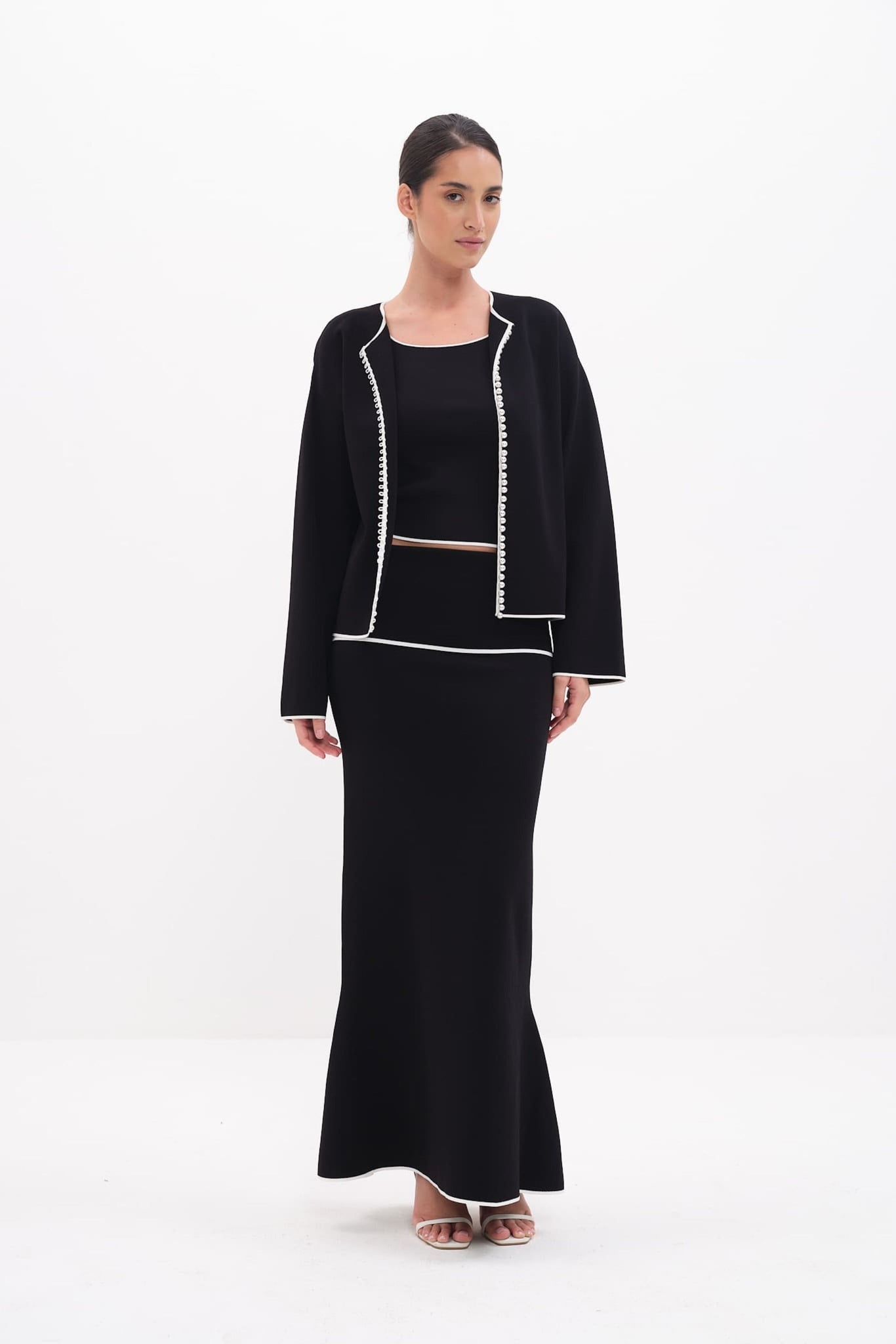
The Seraphine Three Piece Set in viscose knit is a good case study. The knit structure gives it enough elasticity and recovery that it doesn't crumple the way a woven viscose would. You can wear it through a long evening, sit through a multi-course dinner, and the fabric comes through looking clean. It won't look heat-pressed. But it won't look tired either.
If your priority is zero maintenance above all else, polyester wins. If your priority is comfort, drape, and temperature regulation, with reasonable maintenance, viscose wins. Most women I know would rather steam a dress for two minutes than spend a whole evening aware of what they're wearing.
How Each Fabric Feels Against Skin
This is the part that's hard to convey in a product description and almost impossible to communicate in a comparison chart. But it matters more than anything else when you're actually wearing the dress.
Polyester against skin feels smooth in the way a plastic bag is smooth. That's an imperfect comparison because quality varies, and good polyester is far more refined than that. But even good polyester has a slight synthetic slip to it. It doesn't feel warm or cool. It feels neutral in a way that's subtly artificial. Over a few hours, especially in warmth, that neutrality starts to tip toward uncomfortable. The fabric doesn't interact with your skin. It just sits on top of it.
Viscose against skin feels cool. Noticeably cool, in the first moment you put it on. It interacts with your body temperature and your skin's moisture immediately. There's a reason people describe viscose as having a "hand" similar to silk. The fibers are smooth, yes, but they're also responsive. They react to you. Across an evening, that responsiveness is the difference between forgetting what you're wearing and counting the minutes until you can change.
The Environmental Angle, Briefly
Polyester is a petroleum-derived fiber. It doesn't biodegrade. Every polyester garment ever made still exists somewhere, in some form. That's worth knowing, even if it's not the primary reason you choose one fabric over another.
Viscose, particularly newer formulations like Naia (which NÓRA uses across several of its satin pieces), is derived from renewable wood pulp and produced through closed-loop processes that recover and reuse solvents. It biodegrades. It's not perfect, no fabric is, but the trajectory is better. If you're building a wardrobe with any attention to what your clothes are made of and where they end up, viscose is the more considered choice.
TENCEL lyocell and bamboo jersey follow a similar logic, plant-based, biodegradable, produced with lower environmental impact than conventional synthetics. The specific fiber matters less than the principle: natural and semi-synthetic fabrics tend to be gentler on both the wearer and everything else.
What About Blends?
Some brands blend polyester with viscose to split the difference. On paper, this makes sense. In practice, the polyester component tends to dominate the feel. A 60/40 polyester-viscose blend will breathe better than pure polyester, but it won't drape or cool like pure viscose. The synthetic fiber stiffens the hand of the fabric just enough to lose that fluid quality.
Viscose blended with natural fibers, cotton, linen, or with elastane for stretch, is a different story. These blends tend to preserve the drape and breathability while adding structure or recovery. A viscose-cotton knit, for instance, gives you the softness of viscose with a bit more body from the cotton. It's a practical combination that doesn't sacrifice what makes viscose appealing in the first place.
Which Fabric Is Most Cooling?
If we're ranking purely on cooling ability: linen is the coolest natural fiber, followed closely by cotton in an open weave. But linen wrinkles aggressively and has a casual hand that doesn't always suit evening or occasion wear. Cotton can feel stiff in more formal silhouettes.
Viscose sits in a particular sweet spot. It cools nearly as well as linen, drapes far better than cotton, and has a refined surface quality that reads well at dinners, events, and anywhere the dress code leans polished. For the kind of dressing most women do most of the time, viscose is the most practical cooling fabric that still looks intentional.
Polyester ranks low on cooling. Full stop.
Practical Guidance for Dubai (and Anywhere Warm)
If you're dressing for summer in any warm city, here's what holds up across situations:
For evening events, long dinners, anything indoors with air conditioning: viscose satin or viscose knit. The fabric handles temperature shifts between outside and inside without clinging or trapping heat. A longer silhouette in viscose moves beautifully and stays comfortable through hours of sitting.
For daytime, brunches, weekends: viscose knit sets or cotton knit pieces. Less formal, still polished, and genuinely comfortable in heat. NÓRA's sets collection is worth browsing if you prefer the ease of a matched look without the rigidity of a single dress.
For travel: viscose knit over woven viscose, because the knit construction recovers better from packing. And over polyester, because you'll be more comfortable on the plane, at the destination, and everywhere in between.
For weddings and formal occasions: viscose satin or Naia satin. The drape is refined enough for occasion wear, the fabric breathes through long ceremonies, and it photographs with a quality of light that polyester satin can't match. (Polyester satin has a slightly sharper sheen that can look overly reflective in photos. Viscose satin has a softer, more diffused glow.)
The Honest Summary
Polyester is a functional fabric with real advantages in durability and wrinkle resistance. If those are your top priorities, it's a reasonable choice. But for drape, comfort, cooling, and the overall experience of wearing a dress through a warm evening, viscose is better. Measurably, tangibly better.
The question of viscose vs polyester for dresses, which one drapes better and traps less heat, has a clear answer. Viscose drapes better. Viscose traps less heat. And in a city like Dubai, where your outfit has to hold up through dramatic temperature swings and long social occasions, that difference is the one you'll feel most.
NÓRA's festive collection is built almost entirely on viscose, Naia satin, bamboo jersey, and TENCEL. It's worth spending a few minutes with the fabric descriptions. Once you know what you're looking for, the right piece tends to find you quickly.