


What Quality Construction Means in Clothing
Most advice about quality construction in women's clothing starts and ends with "check the seams." That's fine. But it barely scratches the surface.
I've been thinking about this because a friend recently showed me two dresses she'd bought at roughly the same price point. Both looked good on a hanger. Both had clean stitching. But after three wears, one of them had already started to pull at the shoulder, the hem had begun to ripple unevenly, and the fabric had developed a dull, tired quality she couldn't quite name.
The other still looked exactly like it did in the fitting room. Same price. Completely different construction. And that gap, the one between a garment that photographs well and a garment that actually holds up, is what quality construction actually means in women's clothing.
So I wanted to write something more honest than a checklist. Because the truth is, most of us aren't going to stand in a fitting room counting stitches per inch. What we need is a literacy that helps us understand what we're really paying for when we choose one piece over another.
Construction is what happens between the fabric and the finished piece
Think of it this way. A beautiful fabric can be poorly constructed into a garment, and a mediocre fabric can be skillfully handled. Construction is every decision made after the fabric is chosen: how it's cut, how the pieces are joined, how the garment is shaped to move with a body rather than just hang on one.
It includes the obvious things, stitching, seam finishing, hemming. But it also includes things you can't always see: the way a lining is attached (or whether there's one at all), how much seam allowance was left (which determines whether a garment can be altered without falling apart), the direction the fabric was cut relative to its grain, and whether the pattern pieces were laid out to account for how the fabric drapes on a body versus on a table.
That last point is one almost nobody talks about. A dress cut slightly off-grain will twist on your body over time. You'll keep adjusting it all evening without understanding why. You'll think it's your posture. It's the construction.
The details you can actually check
I don't want to give you another checklist, but there are a few things worth knowing, and once you see them, you can't unsee them.
Seam allowances - Turn a garment inside out. If the seam allowances are very narrow, almost shaved to the edge, it usually means the manufacturer prioritized saving fabric over longevity.
Generous seam allowances give a garment structural integrity and room for future tailoring. They're also a sign that someone expected this piece to last.
Pattern matching - Look at any seam where a print or stripe meets itself. If the pattern lines up across the seam, that took extra time and extra fabric. It's not always necessary, but when it's done well, it tells you something about the level of care in the production process.
Hem weight - A well-constructed hem on a flowing dress or gown isn't just folded and stitched. Often there's a weight or a carefully considered finishing technique that keeps the fabric falling properly. Pick up the hem of a dress and feel it. If it's just raw-edged or rolled once and stitched quickly, the drape will deteriorate after washing.
Something like the Rosalia Pleated Maxi in viscose is a good example of how a specific pleating technique, handled with precision, can give structure to a fabric that would otherwise just hang. The construction creates the movement.

Stress points - Where does a garment bear the most tension? Shoulder seams, armholes, the waistline of a fitted dress, the point where a strap meets the bodice. Well-constructed garments reinforce these areas, sometimes with extra stitching, sometimes with interfacing, sometimes with strategic darting.
Fast-fashion garments rarely do this, which is why a strap pops or a seam gives out exactly where you'd predict.
Why the fabric and the construction have to be in conversation
This is the part that separates someone who knows clothing from someone who just shops a lot. The best construction in the world won't save a cheap fabric. And a beautiful fabric, poorly constructed, is just waste with good intentions.
Every fabric has a personality. Satin wants to slide. Knit wants to stretch. Jersey wants to cling. Linen wants to wrinkle. A skilled pattern maker and seamstress works with that personality rather than fighting it.
They know that a Naia satin needs a different seam finish than a bamboo jersey. They know that cutting a knit on the bias will change how it fits across the body entirely. They adjust the construction techniques to the material.
This is why I always look at fabric composition alongside construction. A 100% cotton tee, for instance, is often treated as a sign of quality, and it can be. But cotton construction requires preshrinking the fabric before cutting, otherwise the garment will shrink unevenly after your first wash.
A well-constructed cotton piece accounts for this. A poorly constructed one just hopes you'll hand-wash it forever.
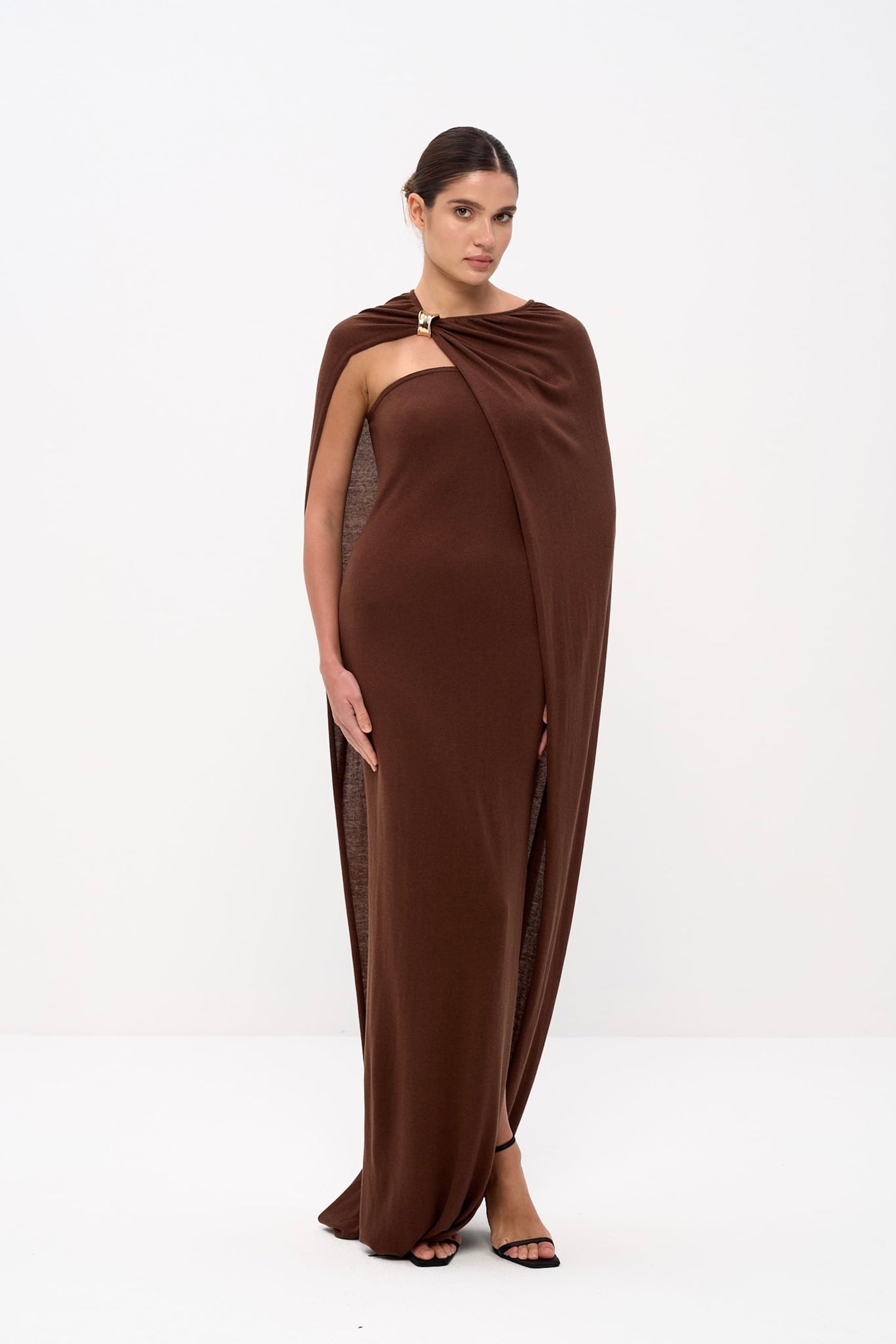
Sustainable fabrics like TENCEL lyocell or bamboo jersey have their own requirements. They tend to drape beautifully but can be tricky to sew because of their softness. A piece like the Thalia Strapless Cape Gown in TENCEL has to be constructed in a way that respects how soft and fluid that fabric is, giving it enough structure to hold a shape without stiffening the drape. That's a construction challenge most people never think about, and it's why two bamboo jersey dresses at the same price can feel like entirely different garments.
What construction looks like in Dubai, specifically
I think this matters more here than in most places. Dubai's climate puts clothing through a particular kind of test. You're in serious air conditioning at breakfast, walking through heat to your car, sitting in another cooled restaurant for lunch, then possibly outside on a terrace by evening.
The temperature swings alone are enough to expose poor construction quickly.
A garment that wasn't constructed for this will start pilling where the fabric rubs against car seats in humidity. The lining will separate from the outer fabric because they expand at different rates. Colors will shift from perspiration if the dye wasn't properly set during production. These are all construction failures, not fabric failures.
Living here, I've learned to pay attention to how a garment responds to a full day. Not how it looks at 9 a.m. when everything looks good, but how it looks at 10 p.m. after it's been through three venue changes and two different climates.
The pieces that still look intentional at the end of the night are the ones where someone thought about construction completeally, not just aesthetically. We wrote more about dressing for this city's particular demands in our guide to what to wear in Dubai.
The difference between "well-made" and "overbuilt"
There's a common misconception that quality construction means heavy construction. More lining, thicker interfacing, more structure. But that's not always true, and in warm climates, it's often the opposite of what you want.
Some of the best-constructed pieces I own are the lightest.
A viscose knit set that feels like almost nothing but somehow never twists, never rides up, never loses its shape. That's precision. The construction is invisible because it was done so well that the garment just works. You don't notice it. You just notice that you feel good all day.
Overbuilt garments, the ones with excessive boning, layers of lining, rigid interfacing throughout, can actually be a sign of compensating for poor fit or cheap fabric. If a dress needs that much structure to hold its shape, the underlying pattern or material probably isn't doing its job.
The goal is appropriate construction. Enough to support the fabric and the silhouette. Not so much that the garment starts to feel like it's wearing you.
How to train your eye (without becoming obsessive)
I'm not suggesting you carry a loupe to the mall. But there are habits that help.
Try the hanger test. Look at a garment on the hanger, then put it on. If the silhouette changes dramatically, in a bad way, that's usually a construction issue. Well-constructed clothing looks good on the body because it was draped on a body or a dress form, not just drawn flat on a computer screen.
Try the sit test. Sit down in the fitting room. Cross your legs. Raise your arms. A well-constructed dress doesn't ride up past a reasonable point. A well-constructed waistband doesn't dig. A well-constructed sleeve doesn't restrict your shoulder. These are basic things, but they require someone to have actually tested the garment in motion during production.
Try the inside-out test. Turn the garment inside out and look at it as if it were the outside. Does it look finished? Are the seams clean? Is there loose thread everywhere? The inside of a garment tells you everything about how much care went into it.
I remember reading somewhere that Coco Chanel insisted the inside of a jacket should be as beautiful as the outside. That's an extreme standard, but the principle is right. The inside is where you find the truth.
Browse through a curated sets collection or a focused dress collection and pay attention to the fabric descriptions, the finishing details mentioned, the care instructions. Brands that talk openly about their construction process, the specific fabrics used, the techniques employed, are usually the ones doing it thoughtfully.
Brands that only talk about the aesthetic are often hiding something.
Why this matters more than trends
Here's what I keep coming back to. Understanding what quality construction actually means in women's clothing changes how you shop permanently. Once you can feel the difference between a garment that was made with intention and one that was made with speed, you stop being seduced by newness alone. You start buying fewer things. The things you buy last longer. Your closet gets smaller and better.
This doesn't mean you have to spend more money, necessarily. It means you have to spend more attention. A well-constructed piece at AED 500 will outperform a poorly constructed piece at AED 5,000. I've seen it happen. Price and quality correlate sometimes, but not always, and the gap between them is where construction lives.
The women I know who dress consistently well, and the ones who look polished at a Tuesday lunch at Scalini and equally polished at a Friday dinner in JBR, aren't buying more clothes than anyone else.
They're buying better-constructed clothes.
They've learned to feel a fabric, check a seam, test a fit. They look for pieces with stories they won't outgrow. (The kind of pieces you reach for on mornings when you have no time and no patience for anything complicated.)
That's what construction gives you, really. Not perfection. Reliability. The quiet confidence of knowing that what you put on this morning will still be right at the end of the day, in the next season, in the next year. That's worth paying attention to.